Automate the junior work and you stop making experts
By Reza Motaghi
On this page
The stethoscope is the emblem of the doctor, and most doctors can no longer use it. In 1997 a team tested 453 residents in internal medicine and family practice on recorded heart sounds. They recognised one cardiac event in five, and the score barely improved with year of training.1 Four years later the same test ran in three countries. Every one scored between 20 and 26 percent.2 The machine that listens for them, echocardiography, had by then been in the clinic for a generation. Nobody decided to stop teaching the ear. The reps went to the machine, and the ear went with them.
That is the shape of the thing this article is about. It has a new name now, deskilling, and a new cause, AI that does the routine work. The instinct behind it sounds like efficiency. Let the tool take the routine cases, the first drafts, the boring reads, and free the seniors for the hard problems. But nobody becomes senior without the routine cases. The eye that catches the hard finding was built on ten thousand easy ones. Automate the junior work and you have not freed anyone. You have stopped making experts.
What "the rep is where the skill lives" means
A rep is one full pass at the task, done by you, with the outcome coming back to you. Reading a case and finding out later what it was. Writing a draft and having it corrected. Flying the approach by hand. Skill is exhaust from repetition of that kind, and only that kind. Watching the tool do it is not a rep. Checking the tool's answer is a different, thinner rep. The skill lives in whichever rep you actually do.
Reps are necessary and they are not sufficient. A large review of deliberate-practice studies measured how much practice explains of the difference between people. About a quarter in games and music, and almost none in the professions.3 I take that seriously. Talent, feedback quality, and the cases you happen to see all matter. But the review measured how much practice explains among people who all did it. Nobody has measured the expert who skipped the reps, because until now nobody could.
The receipt: an eye built without help
I read medical images every day, and I read every case cold before I open any AI answer. My eye is the product of many years of unassisted reads. If a model had read first from the day I started, I do not know what I would be able to see today. That is not modesty. It is the honest state of the evidence, and it is why I keep the cold read as a fixed routine rather than a preference.
The tell is that skipping the rep never feels like losing anything. It feels like efficiency, every single time. Nobody in 1997 felt the ear go. Nobody in an endoscopy suite feels the eye go over three months of assisted cases. The loss shows up later, in a room where the tool is not. By then the person who could have caught it has learned not to look.
It is not only juniors
The study everyone cites is the one that measured seniors. In 2025 a Polish group reported on experienced endoscopists who used an AI detection tool for a few months. Reading without it afterwards, their adenoma detection rate fell from 28 percent to 22.4 These were not trainees. They were doctors with decades of experience and thousands of colonoscopies each. One observational study, four centres, and two published critiques followed, with the authors' reply.5 It is the first of its kind, and it should be read as that: a warning, not a verdict.
Then read the study that changes what the warning means. The same year, in the same specialty, a Krakow group compared endoscopists trained with the AI tool switched on against endoscopists trained without it. The AI-trained group detected more adenomas afterwards, unaided, by five percentage points.6 Same tool. Opposite result. The difference is who did the rep. The trainees used the tool as a coach and still did every case themselves. The seniors let it do the looking. Assisted reps built the eye. Skipped reps lost it.
The field's own history says the same. Radiologists learn to see the gist of a chest film at a glance, and that glance is built by volume. A 2020 study tracked how residents scroll through CT volumes and watched the scrolling change as their expertise grew.7 In breast screening, radiologists who read fewer mammograms a year had higher false-positive rates.8 The eye is a count of reps, and the count is what automation removes.
The pipeline is being cut at the bottom
The routine work was the training set, and it is being removed first. Researchers followed 285,000 American firms. The ones that adopted generative AI cut junior headcount by about eight percent within six quarters, while senior headcount kept growing.9 A Stanford team using payroll data looked at the youngest workers in the most AI-exposed occupations. Their employment sits about 19 percent below where it would otherwise be.10 The authors call that descriptive, not causal, which is the honest label and I keep it. Big technology firms cut new-graduate hiring by a quarter in one year.11
None of these numbers says the juniors were replaced by AI, and a forecast about a job measures the demo, not the work. They say the rung they used to climb was removed. The seniors are safe. The next seniors are not being made.
Aviation solved this on paper
The one industry that has been through this loop wrote the answer down. Airline pilots hand-fly a small fraction of a flight, and the American regulator estimated that automation is in use about 90 percent of the time.12 After a crash in which the crew mishandled the aircraft by hand, the French investigators wrote that manual handling cannot be improvised.13 The pilots, they found, had not trained for it at altitude. The regulator issued a notice encouraging airlines to promote manual flight operations, because continuous use of automation does not reinforce a pilot's skills.14 Then it mandated the rep. Every airline pilot now trains hands-on for slow flight, stalls, and upsets, by rule.15
Nobody in aviation argued that autopilots should go. They argued that the human must keep doing the rep, on a schedule, whether or not the day requires it. That is the whole design.
Three habits that keep the eye
Three, not five, because three are enough and a fourth would be filler. One of them changed after I read the evidence against my first version, and I say where.
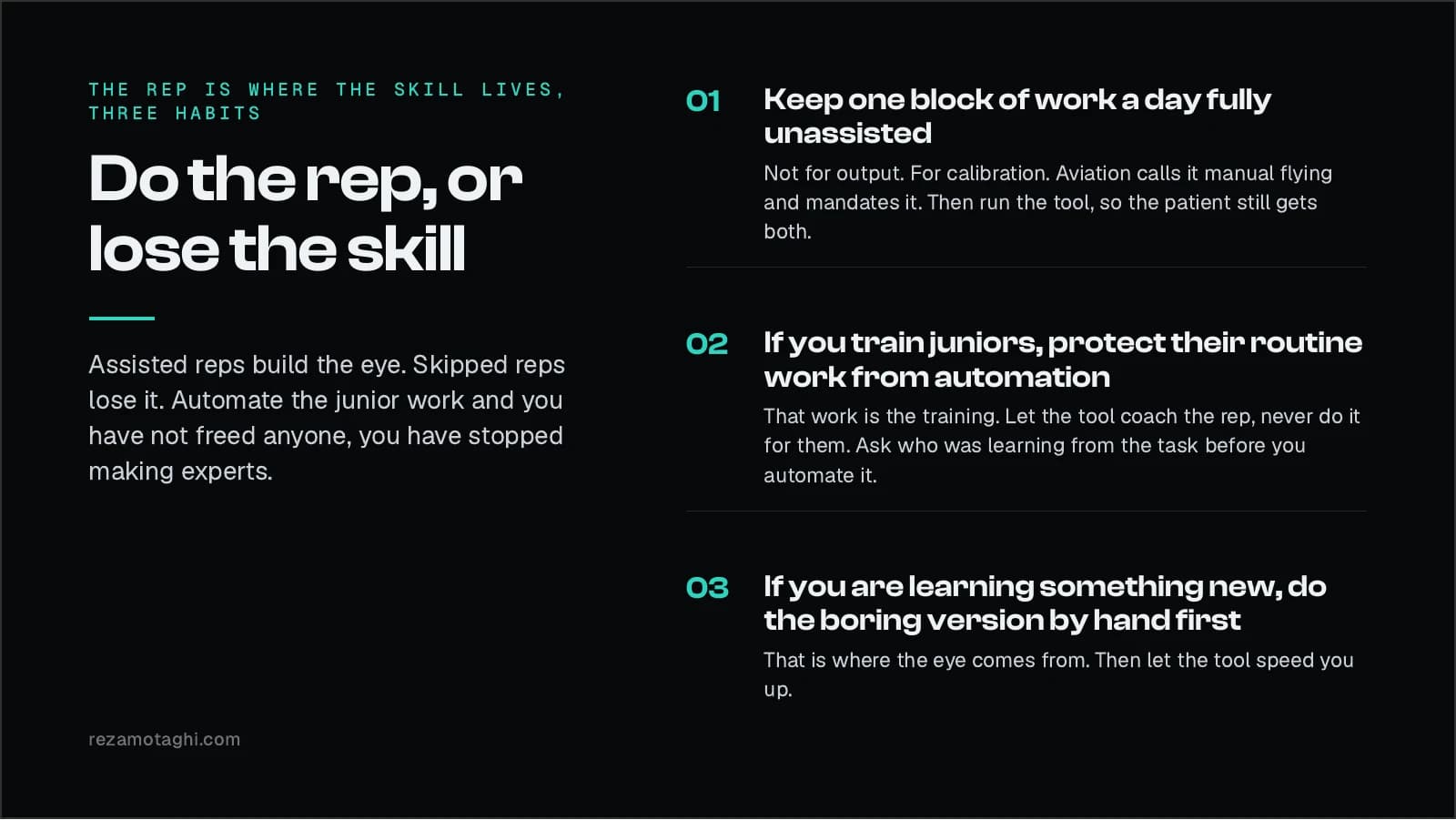
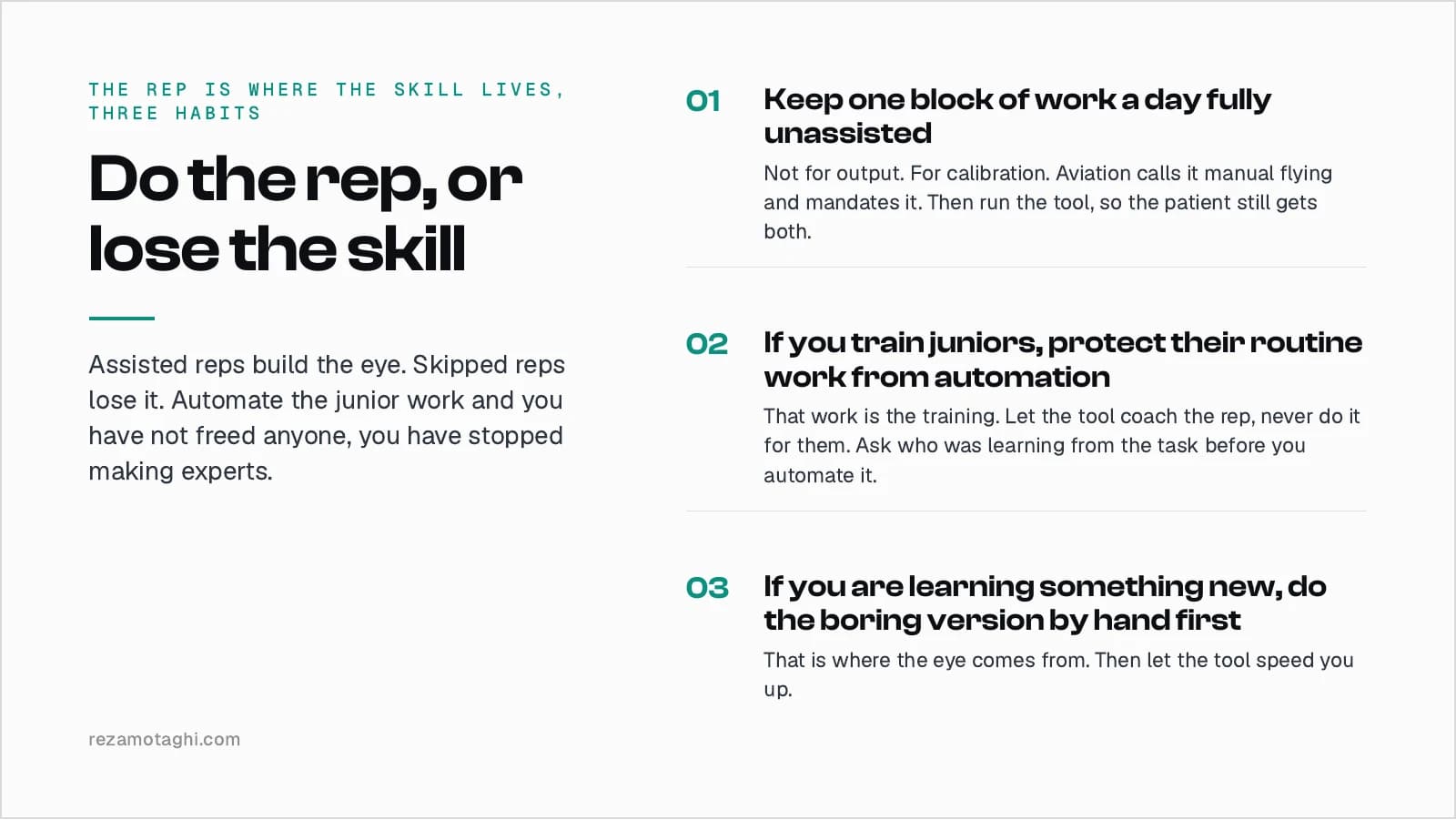
1. Keep one block of work a day fully unassisted. Not for output. For calibration. Aviation calls it manual flying and mandates it. Off-ramp: unassisted does not mean unchecked. Read cold, write your findings, then run the tool, so the patient still gets both. And the change I made: the rep counts even when assisted, as the Krakow trainees showed.6 The daily unassisted block is calibration, not the only rep that matters.
2. If you train juniors, protect their routine work from automation. That work is the training. Let the tool coach the rep, never do it for them. One question before you automate any task: who was learning from doing it. If the answer is nobody, automate it. If the answer is your next senior, keep it. Off-ramp: coaching is not looking away. The tool that flags what the trainee missed is a coach. The tool that reads first is a replacement, and it produces the endoscopy result.
3. If you are learning something new, do the boring version by hand first. That is where the eye comes from. Then let the tool speed you up. I am learning machine learning by hand while models could write the code for me. Same reason I read cold. If the model writes it, I have a model and no way to know when it is wrong. Off-ramp: hand-first is for the skills you must own. Nobody needs to hand-write the parts of the job that never taught anyone anything.
The habit I changed is the first. My first version said "unassisted" as if assisted reps were worthless. The trainee study says the opposite. What matters is that you do the rep. Unassisted is the calibration on top.
What the habits are not
They are not a claim that reps make experts on their own. The practice literature says they do not, and I said so above. They are not nostalgia. The tool that coaches a rep is better than no coach, and the trainee study proves it. And they are not for every task. Most routine work taught nobody anything, and it should go to the machine as fast as it can.
They are for the reps that carry the skill. In medicine that is the reading, the listening, the first draft of the report. Automate those first and you get the 1997 result, in every specialty at once, and you find out in the room where the tool is not.
What I do
I read every case cold first, and I learn the machine learning I use by hand, both for the same reason. The rep is where the skill lives. A model could read my cases first and could write my training code. Then I would have a model, and no way to know when it is wrong. The expert is the dataset, and the expert has to keep being made.
If you are deciding what to automate first, in a department, a training programme, or a product, the research page says what I test and build. The contact page goes straight to my inbox.
References
Footnotes
-
Mangione S, Nieman LZ. Cardiac auscultatory skills of internal medicine and family practice trainees: a comparison of diagnostic proficiency. JAMA, 1997. 453 residents and 88 medical students: residents recognised 20 percent of cardiac events, and the number of correct identifications improved little with year of training. https://doi.org/10.1001/jama.1997.03550090041030 ↩
-
Mangione S. Cardiac auscultatory skills of physicians-in-training: a comparison of three English-speaking countries. American Journal of Medicine, 2001. Mean scores 22 percent in the United States, 26 in Canada, 20 in the United Kingdom, 314 residents. https://doi.org/10.1016/s0002-9343(00)00673-2 ↩
-
Macnamara BN, Hambrick DZ, Oswald FL. Deliberate practice and performance in music, games, sports, education, and professions: a meta-analysis. Psychological Science, 2014. Deliberate practice explained 26 percent of variance in games, 21 in music, 18 in sports, 4 in education, under 1 in professions. https://doi.org/10.1177/0956797614535810 ↩
-
Budzyń K, Romańczyk M et al. Endoscopist deskilling risk after exposure to artificial intelligence in colonoscopy: a multicentre, observational study. Lancet Gastroenterology and Hepatology, 2025. Adenoma detection rate in non-AI colonoscopies 28.4 percent before AI exposure, 22.4 after, absolute difference minus 6.0 percentage points, 1,443 patients, four Polish centres. Secondary reports give 19 endoscopists with over 2,000 colonoscopies each. https://doi.org/10.1016/S2468-1253(25)00133-5 ↩
-
Lam K, and Levartovsky A, Kopylov U, letters, Lancet Gastroenterology and Hepatology, December 2025, https://doi.org/10.1016/S2468-1253(25)00290-0 and https://doi.org/10.1016/S2468-1253(25)00289-4. Budzyń K, Romańczyk M, Mori Y, authors' reply, same issue. https://doi.org/10.1016/S2468-1253(25)00324-3 ↩
-
Orzeszko Z, Gach T, Necka S, Ochwat K, Major P, Szura M. Surgical Endoscopy, 2025. Retrospective cohort, six endoscopists, 6,000 patients: the group trained with computer-aided detection had a higher unaided adenoma detection rate by 5.3 percentage points, 95 percent confidence interval 2.9 to 7.6. https://doi.org/10.1007/s00464-025-11890-3 ↩ ↩2
-
van Montfort D et al. Expertise development in volumetric image interpretation of radiology residents: what do longitudinal scroll data reveal? Advances in Health Sciences Education, 2020. https://doi.org/10.1007/s10459-020-09995-6. On the glance: Kundel HL, Nodine CF. Interpreting chest radiographs without visual search. Radiology, 1975. https://doi.org/10.1148/116.3.527 ↩
-
Buist DS et al. Influence of annual interpretive volume on screening mammography performance in the United States. Radiology, 2011. 120 radiologists, 783,965 screening mammograms: false-positive rates were significantly higher at the lowest total and screening volumes. https://doi.org/10.1148/radiol.10101698 ↩
-
Hosseini Maasoum S, Lichtinger G. Generative AI as seniority-biased technological change. SSRN working paper 5425555, 2025. About 285,000 US firms and 62 million workers; junior headcount at adopting firms fell about 7.7 percent relative to non-adopters within six quarters, senior employment unaffected. https://doi.org/10.2139/ssrn.5425555 ↩
-
Brynjolfsson E, Chandar B, Chen R. Canaries in the coal mine? Six facts about the recent employment effects of artificial intelligence. Stanford Digital Economy Lab, working paper, August 2025, revised 2026. The first version reported about 13 percent, the current version 19 percent below trend for ages 22 to 25 in the most exposed occupations. The authors call the findings early, descriptive indicators rather than causal estimates. https://digitaleconomy.stanford.edu/publication/canaries-in-the-coal-mine-six-facts-about-the-recent-employment-effects-of-artificial-intelligence/ ↩
-
SignalFire, State of Talent Report, 2025: big technology companies cut new-graduate hiring by 25 percent in 2024 compared with 2023. https://www.signalfire.com/blog/signalfire-state-of-talent-report-2025 ↩
-
US Department of Transportation, Office of Inspector General. Enhanced FAA oversight could reduce hazards associated with increased use of flight deck automation. Report AV2016-013, 7 January 2016. "Senior FAA officials estimate that airline pilots use automated systems 90 percent of the time." https://www.oig.dot.gov/sites/default/files/FAA%20Flight%20Decek%20Automation_Final%20Report%5E1-7-16.pdf ↩
-
BEA. Final report on the accident on 1 June 2009 to the Airbus A330-203, flight AF447. July 2012. "Manual aeroplane handling cannot be improvised and requires precision and measured inputs on the flight controls." The report recommends mandatory, regular exercises in manual handling of approach to stall and stall recovery, including at high altitude. ↩
-
FAA. Safety Alert for Operators 13002, Manual flight operations, 4 January 2013. "Continuous use of those systems does not reinforce a pilot's knowledge and skills in manual flight operations." https://www.faa.gov/sites/faa.gov/files/other_visit/aviation_industry/airline_operators/airline_safety/SAFO13002.pdf ↩
-
14 CFR 121.423, Pilot: extended envelope training, from Docket FAA-2008-0677, 78 FR 67839, November 2013. Manually controlled slow flight, loss of reliable airspeed, upset recovery, full stall and stick-pusher training. https://www.law.cornell.edu/cfr/text/14/121.423 ↩