Why AI has not replaced radiologists: what the demo missed
By Reza Motaghi
On this page
The paper that founded computer diagnosis said the opposite of what everyone remembers. In July 1959 two researchers published Reasoning Foundations of Medical Diagnosis in Science, the first serious case for putting a computer next to a doctor.1 Near the end they wrote a sentence that later forecasters never quote. The method, they said, in no way implies that a computer can take over the physician's duties. Quite the reverse. It implies that the physician's task may become more complicated.
Fifty-seven years later, in the autumn of 2016, the forecast flipped. A leading AI researcher told a Toronto audience that people should stop training radiologists now, because within five years deep learning would do better than radiologists.2 The same month a perspective in the New England Journal of Medicine said machine learning would displace much of the work of radiologists and pathologists.3 Serious people, said plainly, with a date on it. The five years ran out in 2021. Today radiology is short of radiologists.
What "the demo and the day" means
A forecast about a job made by someone who never did the job measures the demo, not the work. The demo is the task a tool has been shown doing, and it is usually real. Reading a chest film for a nodule is a demo. The day is everything the job contains, and the day is what the forecast claims to be about. Tasks get automated. Jobs get forecast. They are not the same object.
The demo and the day is the test for the next confident forecast about your work. It works the same for the work of someone you are about to hire, train, or replace. Judge it by one question. Has the person making it done the job for a week. If not, they measured the slice, and the invisible part is usually the job.
The receipt: a day, written out
I read medical images every day, and I build AI for that reading. So here is a day, by activity, the way a forecaster from outside would never see it.
The morning starts with a request, not an image. The clinical question on it changes what I look for before I open the study. Then the old scan, pulled to compare, because half of what a finding means is whether it was there last year. Then the image, which is the slice everyone talks about, and which is a slice. Then the finding that does not fit the question, and the call to the referrer that it needs. Then the protocol question from the technologist about a patient still on the table. Then the report, written for three readers. The clinician who acts on it, the patient who will read it that evening, and the colleague who will read it in two years. Then the decision about what not to say, which is the hardest part of the report and the part no demo covers. Then a resident's question, a discrepancy to reconcile, a critical result to phone through, and the next request.
Nothing in that day is a tool. It is a description of the work. The tools I use and build touch parts of it, and the parts they touch are real, and they were never the day. That is the whole argument. It was there before the forecast, and it is there after it.
What the forecast measured
The forecast measured image reading, and image reading is a minority of the day. This was known three years before anyone said stop training radiologists. In 2012 a Vancouver group followed fourteen radiologists through their working days with a stopwatch. Image interpretation took 36 percent of their time.4 Non-interpretive work took 44 percent: protocolling, supervising studies, procedures, consulting with physicians, direct patient care. They were interrupted by other staff about six times an hour, and most of those interruptions changed a patient's care in real time. The British census of 2025 found consultants spend about half their time reporting.5 The rest is liaison, teaching, and the multidisciplinary meeting.
The forecasters saw a benchmark and a percentage. That was the demo. Nobody who predicted the field away was in the room for the rest of the day.
The five years, and what followed
The horizon expired in 2021. What arrived was not the disappearance of the job but a shortage of people to do it. In the United Kingdom the 2025 census found a 32 percent shortfall of consultant radiologists, the largest on record, and forecast 40 percent by 2030.6 In the United States attrition more than doubled between 2014 and 2022, and imaging volume grew faster than the workforce.7 Meanwhile radiology holds about three quarters of all the AI devices the FDA has authorized.8 More AI in radiology than anywhere else in medicine, and fewer radiologists than the work needs.
Did the forecast cause the shortage. Not alone, and the article's name overstates it on purpose, the way a headline does. I checked, and I want to say what I found. Interest in the field did fall to its lowest point in a generation around 2015, before the loudest forecasts.9 Residency positions are capped by funding, the population is ageing, and imaging demand is growing on its own.7 But among students who still considered radiology, a 2026 survey found a third said the AI forecast pushed them away.10 The forecast did not create the shortage. It arrived while one was forming and told the people who could fix it to go elsewhere. And in 2025 the forecaster who said stop training radiologists said he had been wrong on the timing but not the direction.11 He had been talking, he said, only about image analysis. Which is the point. Image analysis is the slice.
The field has heard this before
Radiology has been forecast away roughly once a decade. In 1963 a Radiology paper described computer diagnosis of bone tumours.12 In the 1960s computers began reading electrocardiograms, and sixty years later a cardiologist still overreads every one, because the limits recognised then persist.13 In 1998 the FDA approved computer-aided detection for mammography. By the 2000s most screening mammograms in America were read with it, at more than 400 million dollars a year. Then a study of 625,000 mammograms read by 271 radiologists found it did not improve accuracy at all.14 In the mid 2000s the scare was offshoring to India. The working paper that went looking found about fifteen Indian radiologists reading American images.15
Each time the tool did a slice, sometimes well. Each time the day stayed. That is not an argument that this time is the same. The current tools are better than any of those, and I build with them. It is an argument that the same measurement error keeps being made, by people outside the room.
When the slice is the job
Sometimes the forecast is right, and the honest version of this piece says so. Ask a literary translator. In a 2024 survey by their professional body, about a third of British translators reported losing work to generative AI, and more than four in ten reported losing income.16 For them the slice was most of the day: source text in, target text out, with less of the adjacent judgment, communication and liability that fills a radiologist's hours. Early-career workers in the most AI-exposed occupations are already fewer than they would have been.17 The test is not "AI cannot do jobs". The test is who has to be present for the rest of the day, and for some jobs the answer is nobody.
The five moves
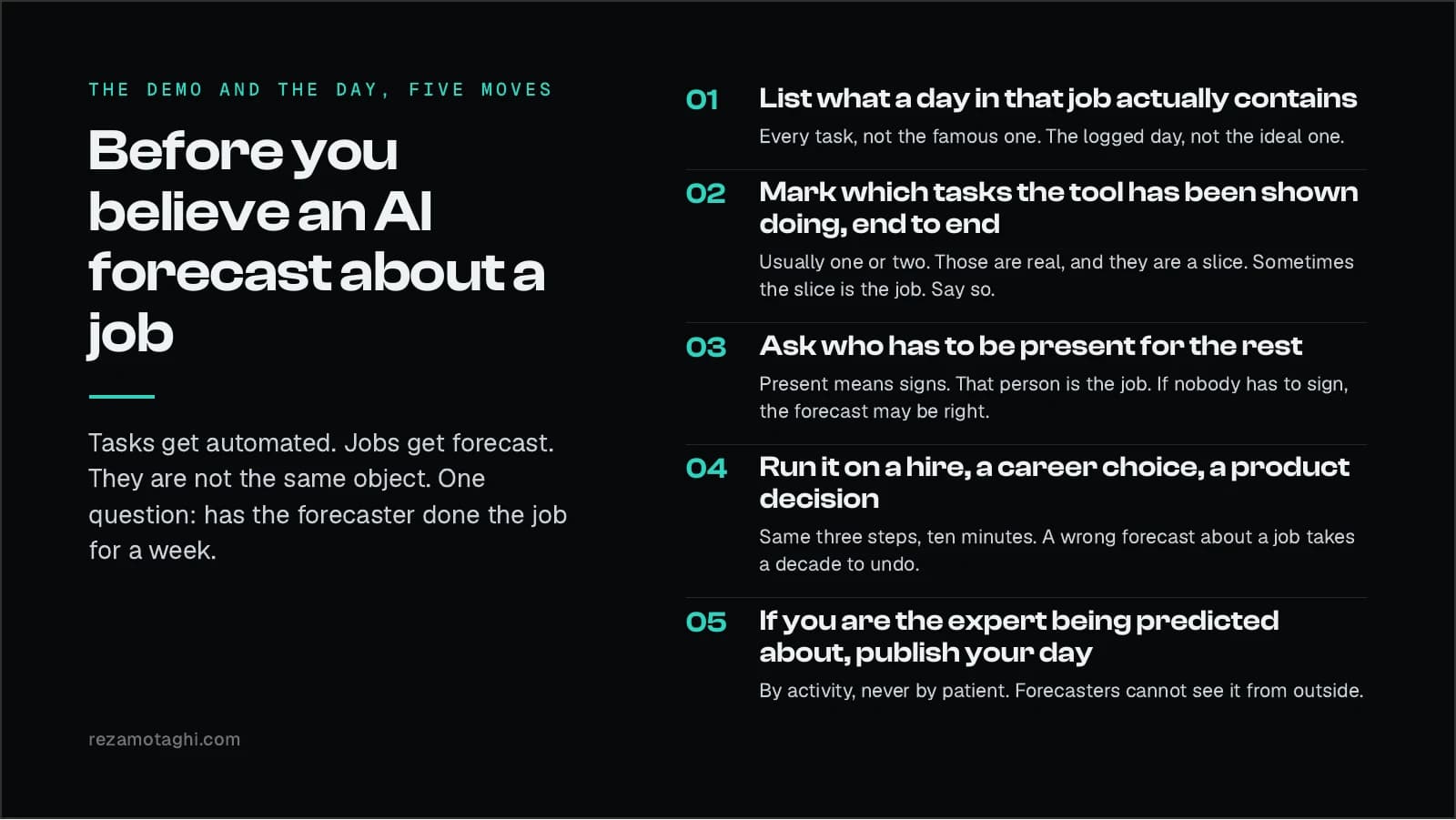
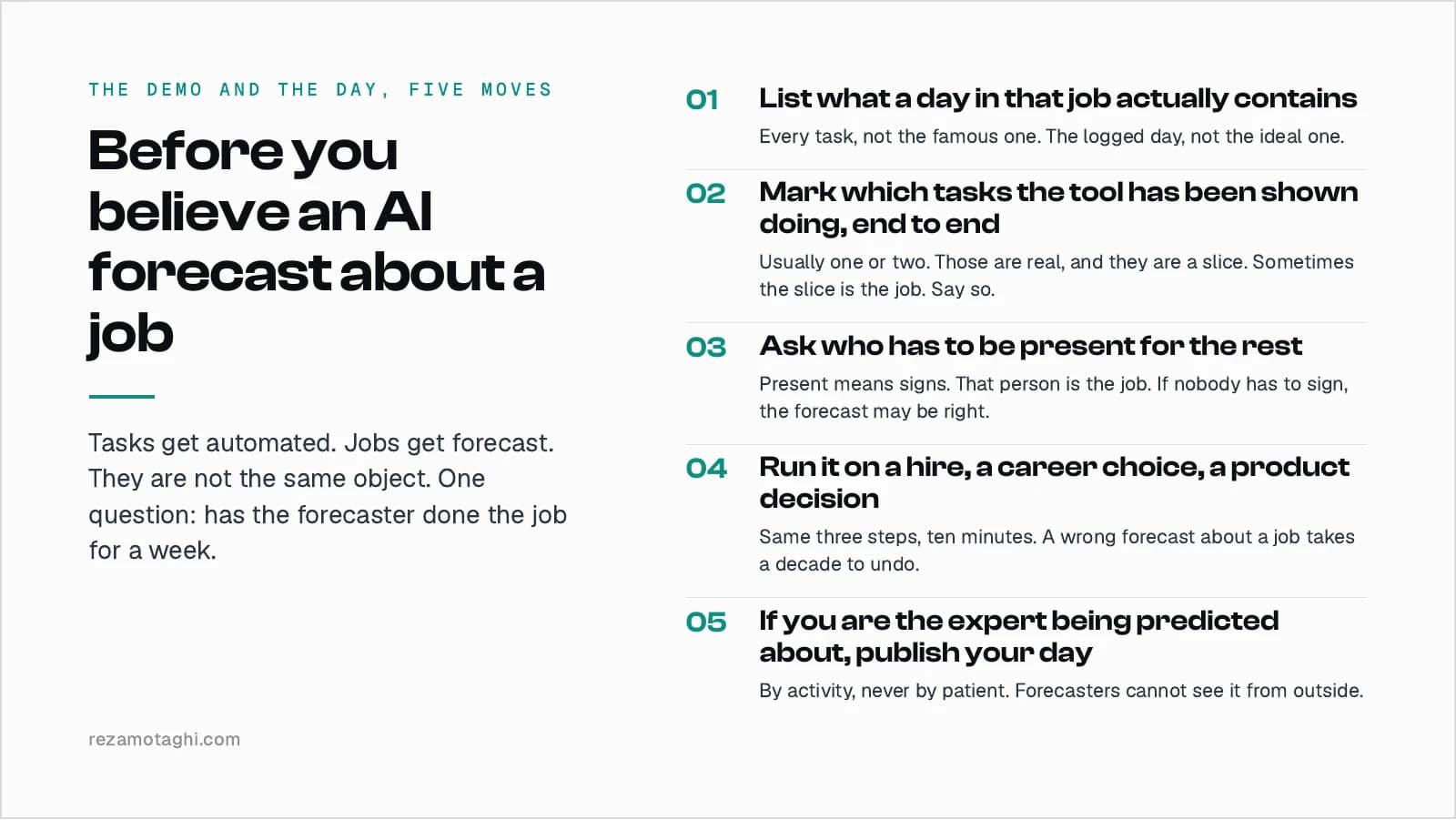
Five moves before you believe the next forecast about a job. Two of them changed after I read the evidence against my first version, and I say where.
1. List what a day in that job actually contains. Every task, not the famous one. The Vancouver stopwatch is the model: follow the person, write down what they do.4 Off-ramp: list the logged day, not the ideal one, and not the one the job description promises. If you cannot describe the day, you cannot forecast it.
2. Mark which tasks the tool has been shown doing, end to end. Usually one or two. Those are real, and they are a slice. In breast screening an AI-supported read cut screen-reading workload by 44 percent in a Swedish trial while detecting more cancers.18 A chest x-ray tool holds a European mark to clear normal films with no radiologist.19 End to end means in your setting, not in the demo, because the runtime is part of the instrument. Off-ramp, added after the evidence: sometimes the slice is the job. If the marked tasks are most of the day, the forecast may be right, and pretending otherwise is the mirror error. Say so.
3. Ask who has to be present for the rest. Present means signs. The report carries a name, and someone has to be the name. Off-ramp: "present" is not "busy". If the rest of the day could be done by anyone, or by nobody, the forecast is right about the job even if the tool only does the slice.
4. Run it on a hire, a career choice, a product decision. Same three steps, ten minutes. Off-ramp, added after the evidence: do not over-correct into "the tool does nothing". A wrong forecast in either direction takes a decade to undo, because the training pipeline is a decade long. Price the slice honestly and staff the day.
5. If you are the expert being predicted about, publish your day. Forecasters cannot see it from outside, and the field's own studies are old and few. Off-ramp: publish by activity, never by patient. A day written out is a description of work, not a log of people.
The two I changed are the second and the fourth. My first version treated the slice as always small. The translators made me write the off-ramp. And my first version of the fourth move was a warning against forecasters. The residency numbers made it a warning against both directions.
What the moves are not
They are not a claim that AI will not change the job. It already has, and I am part of changing it. They are not a claim that radiologists are safe. A field short by a third is not safe, it is stretched. And they are not nostalgia for the day as it is. Some of the day should go to a tool, and the sooner the better.
They are a way of asking the right question. The 1959 paper asked it first: the computer is an aid, and the physician's task gets more complicated, not smaller. Sixty-seven years on, that is still the better forecast.
What I do
I read images every day, and I build and evaluate the AI that reads them, so both jobs tell me the same thing. The tool does the visible slice, and it does it better every year. The visible slice was never the job. Nobody who has done the day for a week predicts the day away.
If you are making a call about a job that AI touches, a hire, a curriculum, a product, the research page says what I test and build. The contact page goes straight to my inbox.
References
Footnotes
-
Ledley RS, Lusted LB. Reasoning foundations of medical diagnosis. Science, 3 July 1959. "The mathematical techniques that we have discussed and the associated use of computers are intended to be an aid to the physician. This method in no way implies that a computer can take over the physician's duties. Quite the reverse; it implies that the physician's task may become more complicated." https://doi.org/10.1126/science.130.3366.9 ↩
-
Geoffrey Hinton, Creative Destruction Lab, Machine Learning and the Market for Intelligence, Toronto, November 2016. "People should stop training radiologists now. It's just completely obvious that within five years deep learning is going to do better than radiologists." Video posted 24 November 2016. https://www.youtube.com/watch?v=2HMPRXstSvQ ↩
-
Obermeyer Z, Emanuel EJ. Predicting the future: big data, machine learning, and clinical medicine. New England Journal of Medicine, 29 September 2016. "Machine learning will displace much of the work of radiologists and anatomical pathologists." https://doi.org/10.1056/NEJMp1606181 ↩
-
Dhanoa D, Dhesi TS, Burton KR, Nicolaou S, Liang T. The evolving role of the radiologist: the Vancouver workload utilization evaluation study. Journal of the American College of Radiology, 2013. Fourteen radiologists, three hospitals, one month of observation: 36.4 percent of time on image interpretation, 43.8 percent on non-interpretive tasks, six interactions an hour, 81.2 percent of them influencing patient care in real time. https://doi.org/10.1016/j.jacr.2013.04.001 ↩ ↩2
-
Royal College of Radiologists. Clinical radiology workforce census report 2025. Consultants spend about 48 percent of their time reporting, 10 percent on clinical liaison, 23 percent teaching and supervising, 16 percent on multidisciplinary meetings. https://www.rcr.ac.uk/news-policy/workforce-censuses/2025-clinical-radiology-workforce-census-report/ ↩
-
Same census: 32 percent consultant shortfall, the largest recorded, forecast 40 percent by 2030. ↩
-
American College of Radiology, ACR Bulletin, 2026, the radiologist shortage: a workforce update from the Neiman Health Policy Institute. Attrition rose from 1.1 to 2.5 percent a year between 2014 and 2022. Neiman HPI, Projected US radiologist supply, 2025 to 2055, JACR 2025: supply up 25.7 percent by 2055 without new residency positions against imaging demand up 16.9 to 26.9 percent. https://www.acr.org/Clinical-Resources/Publications-and-Research/ACR-Bulletin/2026/radiologist-shortage-work-force-update ↩ ↩2
-
FDA, Artificial intelligence-enabled medical devices list, tabulated by The Imaging Wire, March 2026: about 76 percent of all authorizations are radiology. https://www.fda.gov/medical-devices/software-medical-device-samd/artificial-intelligence-enabled-medical-devices ↩
-
Deng F, Moy L. The US radiology residency match: update and multidecade trends. Radiology, 2023. The share of US MD seniors applying to radiology fell to a nadir of 3.8 percent in 2015. https://doi.org/10.1148/radiol.232064 ↩
-
Canadian survey of 401 medical students and residents, Academic Radiology, 2026, as reported by The Imaging Wire, May 2026: among those interested in radiology, 33 percent said AI discouraged them, 13 percent encouraged, 33 percent no influence. ↩
-
Lohr S. Your A.I. radiologist will not be with you soon. New York Times, 14 May 2025. Hinton: wrong on the timing but not the direction, and speaking in 2016 only about image analysis. ↩
-
Lodwick GS et al. Computer diagnosis of primary bone tumors. Radiology, 1963. https://doi.org/10.1148/80.2.273 ↩
-
Schläpfer J, Wellens HJ. Computer-interpreted electrocardiograms: benefits and limitations. Journal of the American College of Cardiology, 2017. "Limitations in the diagnostic accuracy were soon recognized and still persist. Over-reading and confirmation by an experienced ECG reader are essential." https://doi.org/10.1016/j.jacc.2017.07.723 ↩
-
Lehman CD, Wellman RD, Buist DS, Kerlikowske K, Tosteson AN, Miglioretti DL. Diagnostic accuracy of digital screening mammography with and without computer-aided detection. JAMA Internal Medicine, 2015. 625,625 mammograms, 323,973 women, 271 radiologists, 66 facilities, 2003 to 2009: sensitivity 85.3 percent with CAD versus 87.3 without, specificity 91.6 versus 91.4, cancer detection 4.1 per 1,000 in both. https://doi.org/10.1001/jamainternmed.2015.5231 ↩
-
Levy F, Yu KH. Offshoring radiology services to India. MIT Industrial Performance Center working paper 06-005, 2006. "About fifteen Indian radiologists currently read US images." Wachter RM. The "dis-location" of US medicine: the implications of medical outsourcing. New England Journal of Medicine, 2006. https://doi.org/10.1056/NEJMp058258 ↩
-
Society of Authors, AI survey, January 2024, 787 respondents: 36 percent of translators had lost work to generative AI, 43 percent reported decreased income. Reported by the European Writers' Council and others; the society's own page carries the survey. ↩
-
Brynjolfsson E, Chandar B, Chen R. Canaries in the coal mine? Six facts about the recent employment effects of artificial intelligence. Stanford Digital Economy Lab, working paper, August 2025, revised 2026. Employment of workers aged 22 to 25 in the most AI-exposed occupations was about 13 percent below trend in the first version. https://digitaleconomy.stanford.edu ↩
-
Lång K et al. Artificial intelligence-supported screen reading versus standard double reading in the Mammography Screening with Artificial Intelligence trial (MASAI). Lancet Oncology, 2023. Screen-reading workload down 44 percent, 244 versus 203 cancers detected in the interim analysis. https://doi.org/10.1016/S1470-2045(23)00298-X ↩
-
Oxipit ChestLink, CE Class IIb, March 2022: autonomous reporting of chest x-rays with no abnormality, without a radiologist. ↩