Why the strongest one-person company is built from a day job
By Reza Motaghi
On this page
The first ultrasound pictures of an unborn child came out of a boiler factory. In July 1955 an obstetrician in Glasgow carried the morning's operating specimens to the Babcock and Wilcox works in Renfrew.1 Uterine fibroids and a large ovarian cyst, removed a few hours earlier. He ran the plant's steel flaw detector over them, the instrument the technicians used to find cracks in welds. Three years later his team published the first ultrasound images of a fetus in the Lancet.2 Two years before him, a cardiologist in Sweden had borrowed the same kind of instrument from a shipyard and watched the heart move.1 Neither of them left the wards to do it. Ian Donald held the chair of midwifery in Glasgow the whole time.
That is how the instruments of medicine used to get built. The person with the problem borrowed a tool, tested it on the cases in front of them, and published under their own name. Then the story of building changed hands. Today the story of the one-person company is told as a tooling story. A generalist, good tools, a laptop, a niche found on a market map. There are no doctors in it. There are no engineers, lawyers, or teachers in it either, not as professionals. The strongest one-person company I know is powered by a profession, and the story leaves that out on purpose.
What "standing, not stack" means
The moat of a one-person company is not the tool stack. It is the standing. Standing is what a working profession hands you before you write a line of code. A supply of real problems. A bench of real cases to test on. Trust earned before the product existed. A profession is a problem generator, a test bench, and a trust account. One person can hold all three.
The tooling story sells the opposite. It says the tools are the moat, and it keeps you buying more of them in the hope that the next one is the niche. But everyone can rent the stack. Nobody can rent your Tuesday afternoon with a patient waiting and a tool that does not do what you need. That afternoon is the roadmap. It never lies, because you did not choose it.
The receipt: a viewer built between reads
I read medical images every day, and I evaluate frontier vision models on my own cases. Doing that properly needs an instrument nobody sold. A viewer an AI agent can drive. The agent reproduces a viewing context exactly, takes a snapshot of what it saw, and leaves the reading to me. Nothing I could open would let an agent navigate a scan while I kept my hands on the case. So I built one, alone, in the hours around a full clinical load. It is called CBCTScope. It is free and open source. Every feature in it graduated from my own worklist, and it is the first CBCT viewer with native AI-agent control.
The tell is what the agent cannot do. It moves the view, switches reading modes, sets the window, walks the slices, takes snapshots. It never returns a finding. There is no verb that measures a lesion and calls it a lesion, no verb that reads. I wrote about why when it shipped, and the short version is that the fence came from the profession, not from a product meeting. A radiologist knows exactly where a viewer stops being a viewer and starts being a diagnostic device. That knowledge is not in any tool stack.
The tell of the tooling story is the reverse. When the person with the problem and the person with the compiler sit in different rooms, the fences get drawn last. By lawyers, after the demo. When they are the same person, the fence is drawn first, and it is a feature.
Where the evidence points
The professionals who build were never rare. They were the norm, and the research has said so for fifty years. Eric von Hippel studied scientific-instrument innovations at MIT in the 1970s. About four in five significant ones came from users, who invented, prototyped and first field-tested them, not from the manufacturers.3 A British study of medical equipment found the same pattern a decade later. In half of the innovations, the user had built the prototype.4
Physicians in particular kept building. A Health Affairs study of American medical-device patents from the 1990s found physicians named on almost one in five.5 Their patents drew more citations than the rest. The pattern holds for whole companies. The Kauffman Foundation followed thousands of American startups from their first year. Among the innovative ones that survived to age five, almost half had a user of the thing as founder.6 The users who built for their own job, not for a hobby, reported more revenue and more patents than the average founder.
The founder research agrees. A study of American high-growth startups looked at prior experience in the industry a founder entered. Founders who had it were about twice as likely to build a top-growth company.7 The average founder of one was 45. And a study in the Academy of Management Journal followed people who started ventures while keeping their jobs. Those who tested the water first, then went full time, were about a third less likely to fail than the ones who quit on day one.8 The story skips both numbers, because both point at the professional it left out.
Why the story left them out
Two forces moved the builder out of the profession's room. The first is culture. Somewhere between Donald's flaw detector and now, the working professional was recast as a user. Someone else builds, you adopt. Medical school teaches you to read the image, not to change the software that shows it. That is a choice, and it is recent.
The second force is real and deserves respect. Employers write clauses. Physician contracts routinely carry a moonlighting clause and an intellectual-property clause. The profession's own ethics rules bind what a physician may sell to a patient.9 The regulator draws a line too. In Europe, software that informs a diagnostic decision is a medical device, and it needs a notified body, a quality system, and a file.10 In the United States the line runs in a similar place.11 These are not reasons to stay a user. They are the fences, and the professional is the one person who knows exactly where they run.
Two radiologists showed the two honest ways through. Antoine Rosset, a radiologist in Geneva, started writing OsiriX in 2003. He went back to his hospital post the next year and kept reading while the viewer grew.12 By the project's own count it became one of the most used DICOM viewers in the world, and it stayed on the viewer side of the line. Michael Abramoff, a retina specialist at the University of Iowa, went the other way. He wanted an AI that could tell a primary care office whether a diabetic patient needed to see an eye doctor. That is a diagnosis, so he took the long road across the line. A prospective trial of 900 patients across ten primary care sites.13 Then, in 2018, the first FDA authorization of an AI that makes a screening decision with no clinician reading the image. Same profession, same standing, two different fences. Both were set by the person who knew the work.
The five moves
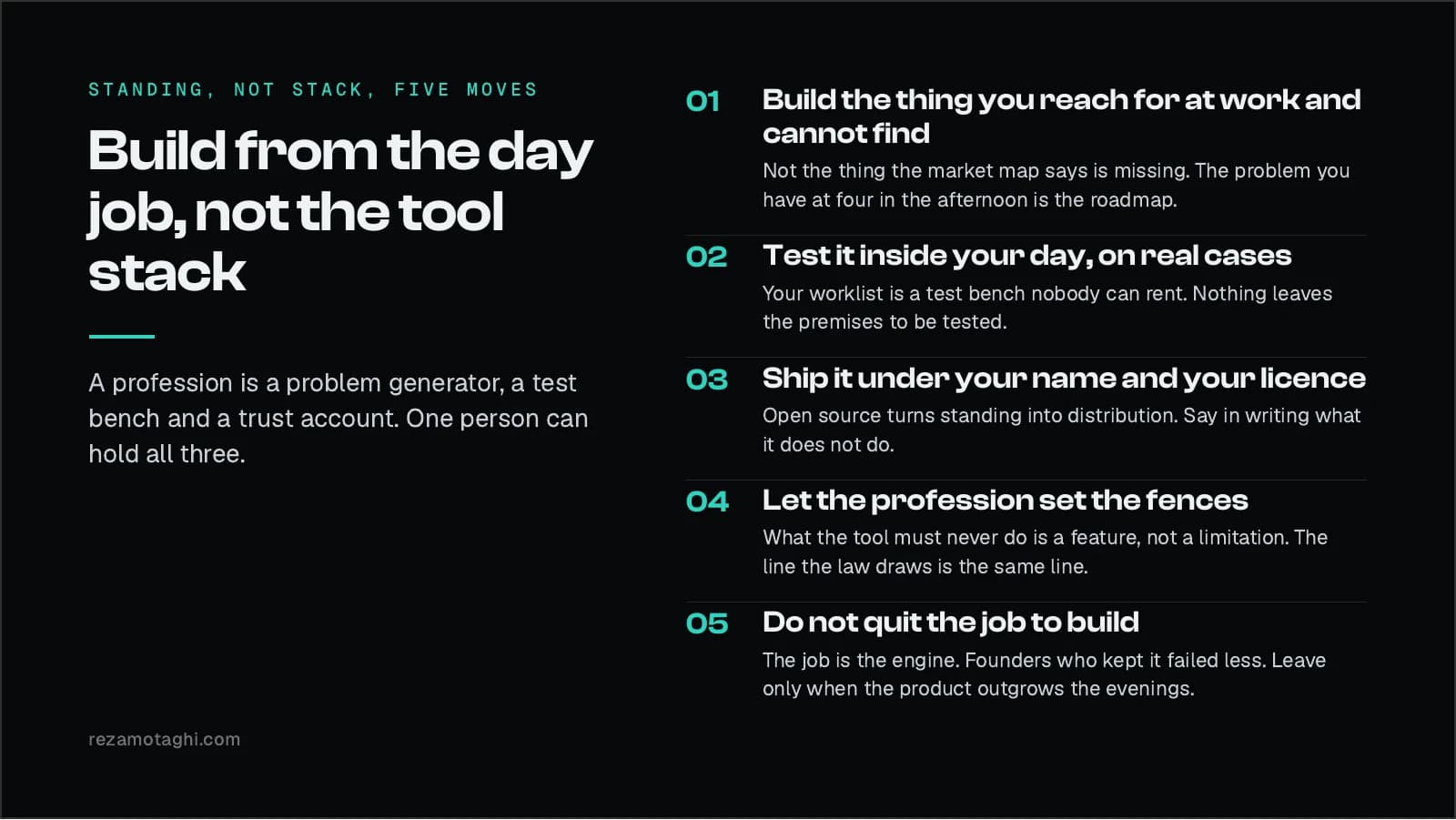
Standing, not stack, is a set of moves, not a slogan. Five of them, in the order I would run them if I had a profession and a half-finished tool. Two carry a warning I added after reading the evidence against them.
1. Build the thing you reach for at work and cannot find. Not the thing the market map says is missing. Von Hippel's users did not run surveys. They had a measurement to make and no instrument, so they built the instrument.3 Off-ramp: if the thing exists and is merely expensive or annoying, buy it. The move is for the tool that does not exist, and the test is that you would use it next week. Building beats planning only when the plan was written by the problem.
2. Test it inside your day, on real cases. Your worklist is a test bench nobody can rent, and it is also the trust account. Every case that goes through the tool is a case you signed. Off-ramp: nothing leaves the premises to be tested. CBCTScope reads scans in place and never uploads. Its demo mode ships a synthetic phantom generated in code, so a stray screen recording cannot leak a patient by accident; the one real scan shown on its page is there on purpose, with written consent, de-identified, rendered bone only. If a test needs patient data on someone else's server, that is not a test, that is a breach with a hypothesis.
3. Ship it under your name and your licence. Open source turns standing into distribution, because the profession already knows the name on the file. Rosset shipped under his own. Off-ramp: say in writing what the tool does not do, and do not ship what you cannot maintain. Open source is fragile at one maintainer, and a tool that goes stale in a hospital is worse than no tool.14 Ship small, document the fences, and choose a licence with teeth. Mine is AGPL.
4. Let the profession set the fences. What the tool must never do is a feature, not a limitation. The agent in my viewer navigates and never reads, and the law draws its line in the same place. That is not a coincidence, it is the point: the professional knows the fence before the lawyer does. The same rule shaped what I refuse to teach a model when I write training examples from my own reads. Off-ramp: if the value of your tool sits on the far side of the line, as Abramoff's did, the day job alone will not carry it. Cross the line the way he did, with a trial and a file, or do not cross it.
5. Do not quit the job to build. The job is the engine. It funds the build, supplies the cases, and keeps the trust account open. The founders who tested the water while employed failed less.8 Off-ramp, added after reading the evidence: that study measured people who eventually did leave, so keeping the job is the way in, not a vow. A build that needs a regulatory run or a sales team outgrows the evenings. Leave when it does, not before. And check the contract first. A moonlighting clause is a fence too.
The two I changed after reading against them are the third and the fifth. I had written "ship it" and "keep the job" as plain rules. The maintainer numbers made the first conditional. The day-job study made the second a starting position rather than a rule, and the article says so.
What the moves are not
They are not a claim that solo beats teams. The evidence on that is split, and this piece does not need it.15 They are not a side hustle. A side hustle is a second job, and this is the first job doing what it always did before someone told it to stop. They are not for everyone with a profession. Most professionals should keep buying their tools, and the ones who should build already know which afternoon I mean.
And they are not about software. Donald's instrument was a borrowed flaw detector and a stack of specimens. The pattern is older than the compiler. The person with the problem builds the tool, tests it on their own cases, and puts their name on it. Software only made the last step cheaper.
What I do
I read images, I evaluate frontier vision models on them, and I build the instruments the evaluation needs, in the open, from inside the job. Ten years of building inside healthcare taught me that the software was never the hard part. Knowing which problem is real is. That knowledge does not come from a market map. It comes from having the problem at four in the afternoon, with a patient waiting.
If you build or evaluate models that look at radiographs and want a radiologist who builds on your side of the table, the research page says what I test. The contact page goes straight to my inbox.
References
Footnotes
-
Whittingham T. The Diasonograph story. Medical Physics International, Special Issue, History of Medical Physics 6, 2021, pp 565 onward. The July 1955 second visit to the Babcock and Wilcox works at Renfrew, with fibroids and an ovarian cyst removed that morning, and the Kelvin and Hughes flaw detector. Edler and Hertz in Lund borrowed an industrial flaw detector from a shipyard in 1953. http://www.mpijournal.org/pdf/2021-SI-06/MPI-2021-SI-06-p565.pdf ↩ ↩2
-
Donald I, MacVicar J, Brown TG. Investigation of abdominal masses by pulsed ultrasound. The Lancet, June 1958. https://doi.org/10.1016/S0140-6736(58)91905-6 ↩
-
von Hippel E. The dominant role of users in the scientific instrument innovation process. Research Policy, 1976. 111 innovations, about 80 percent of those judged significant were invented, prototyped and first field-tested by users. https://doi.org/10.1016/0048-7333(76)90028-7 ↩ ↩2
-
Shaw B. The role of the interaction between the user and the manufacturer in medical equipment innovation. R&D Management, 1985. 34 British innovations, the user built the prototype in 18. https://doi.org/10.1111/j.1467-9310.1985.tb00039.x ↩
-
Chatterji AK, Fabrizio KR, Mitchell W, Schulman KA. Physician-industry cooperation in the medical device industry. Health Affairs, 2008. Physicians on almost 20 percent of about 26,000 US medical device patents filed 1990 to 1996. https://doi.org/10.1377/hlthaff.27.6.1532 ↩
-
Shah SK, Winston Smith S, Reedy EJ. Who are user entrepreneurs? Findings on innovation, founder characteristics, and firm characteristics. Ewing Marion Kauffman Foundation, 2012. Kauffman Firm Survey, 4,928 firms founded in 2004: 10.7 percent of startups surviving to age five were founded by users, 46.6 percent of innovative ones. https://www.kauffman.org/wp-content/uploads/2019/12/whoareuserentrepreneurs.pdf ↩
-
Azoulay P, Jones BF, Kim JD, Miranda J. Age and high-growth entrepreneurship. NBER Working Paper 24489, 2018, published in American Economic Review: Insights, 2020. Prior industry experience roughly doubles the odds of a top 1-in-1,000 growth venture, mean founder age 45. https://www.nber.org/papers/w24489 ↩
-
Raffiee J, Feng J. Should I quit my day job? A hybrid path to entrepreneurship. Academy of Management Journal, 2014. Hybrid entrepreneurs about 33 percent less likely to exit than those who entered full time. https://doi.org/10.5465/amj.2012.0522 ↩ ↩2
-
AMA Code of Medical Ethics, opinions on physicians' financial interests and physician self-referral. https://code-medical-ethics.ama-assn.org/ethics-opinions/physician-self-referral ↩
-
Regulation (EU) 2017/745 on medical devices, Annex VIII, Rule 11: "Software intended to provide information which is used to take decisions with diagnosis or therapeutic purposes is classified as class IIa" and up. MDCG 2019-11, Guidance on qualification and classification of software, sets the other side of the line: software limited to storage, communication, simple search or display does not qualify as medical device software. https://health.ec.europa.eu/system/files/2020-09/md_mdcg_2019_11_guidance_en_0.pdf ↩
-
Federal Food, Drug, and Cosmetic Act, section 520(o)(1), added by the 21st Century Cures Act, 2016: software limited to transferring, storing, converting or displaying data is not a device, and the clinical decision support carve-out is unavailable to any function that acquires, processes or analyzes a medical image. FDA, Clinical Decision Support Software, guidance, 2022, republished 2026. https://www.fda.gov/media/109618/download ↩
-
OsiriX project history. Started November 2003 by Antoine Rosset, radiologist, Geneva, who returned to Geneva University Hospital in October 2004. User figures are the project's own. https://www.osirix-viewer.com/about/story/ ↩
-
Abràmoff MD, Lavin PT, Birch M, Shah N, Folk JC. Pivotal trial of an autonomous AI-based diagnostic system for detection of diabetic retinopathy in primary care offices. npj Digital Medicine, 2018. 900 enrolled at 10 sites. FDA De Novo authorization of IDx-DR, April 2018, "the first device authorized for marketing that provides a screening decision without the need for a clinician to also interpret the image or results". https://doi.org/10.1038/s41746-018-0040-6 ↩
-
Avelino G, Passos L, Hora A, Valente MT. A novel approach for estimating truck factors. ICPC, 2016. Of 133 popular GitHub systems, 65 percent would stall if two or fewer people left. Coelho J, Valente MT. Why modern open source projects fail. ESEC/FSE, 2017. Lack of time and lack of interest of the main contributor were among the leading causes across 104 abandoned projects. https://doi.org/10.1145/3106237.3106246 ↩
-
Greenberg J, Mollick E. Sole survivors: solo ventures versus founding teams. SSRN, 2018, solo Kickstarter ventures survived longer. https://doi.org/10.2139/ssrn.3107898. Against it, First Round Capital's ten-year review, 2015, teams outperformed solo founders on valuation growth. The piece takes no side. ↩