Why your miss costs more when the AI caught it
By Reza Motaghi
On this page
In June 1998 the FDA approved the first computer-aided detection system for mammography. The approval order defined the machine by its place in the order of reading.1 It was to mark regions of interest and bring them to the radiologist's attention "after the initial reading has been completed". The machine spoke second, by definition, on the regulator's own page.
The rule has not gone away. Today the labelling of such software has to state its intended reading protocol.2 What no label says is what a reviewer will make of the order once something has been missed. In 2025 and 2026 two studies asked mock juries, and the juries had a clear view.
If you sign work a machine has also touched, the question is yours. A lawyer files the brief a tool drafted, an engineer seals the drawing the software laid out, an auditor signs numbers a system flagged first. This piece is about what a reviewer does with the order in which you and the machine read, and what your record has to hold.
I read medical images every day, and I run frontier vision models blind, against a two-radiologist reference. My read is on paper before I open what the vision model saw. When the two disagree, I go back to the image and write one line with my reason and the time. That order is a line in my record now, not a habit, and this piece is why.
What the read on the record is
The read on the record is your own read, written before the machine speaks, kept in the file with its time. Around it sit three more lines: the timestamps of the flag and of your final call, the reason for any overrule written when you made it, and the tool's error rates measured on your own cases with the version they belong to. Four lines, about a minute a case, and they do not make your read more accurate. They make it yours, in a form a stranger can check a year later.
The idea underneath is older than AI: a second opinion is only worth something when it was formed alone. The cold read already carries the craft of forming one, with the screening evidence behind it. This piece starts where that one stops. What a jury does with the order, why a later reviewer sees what you could not, and what the record has to hold.
What a mock jury does with the order
Two randomised studies from one lab put the same wrong read in front of mock juries. In the first, published in NEJM AI in 2025, 1,334 US adults judged a radiologist who had missed a finding.3 The vignettes were identical except for whether an AI system had been used, and what it had said.
When the AI had caught the miss, jurors sided with the patient more often. For a missed brain bleed, 72.9 percent found the radiologist at fault, against 56.3 percent when no AI was mentioned. For a missed cancer in the chest, 78.7 percent against 65.2.
A machine that shared the miss did not measurably help. With the AI also missing the bleed, the share was 50.0 percent, close to the no-AI figure.4 The penalty is not for using the tool. It is for being caught by it.
The second study, in Nature Health in 2026, changed one thing, the order.5 All 282 jurors saw a missed brain bleed the AI had flagged, and the radiologist ended on the same wrong answer in both arms. When the radiologist had read once, after the flag, 74.7 percent sided with the patient. When the radiologist had read first without the AI and then again with it, 52.9 percent did.
Same miss, same machine, and about 22 points of penalty decided by which came first.6 And more than half of those jurors still sided with the patient. Reading first does not clear you. It costs you less.
Why the reviewer sees what you could not
The reviewer of a miss is not looking at the image you looked at. In a Journal of Medical Imaging experiment, 40 experienced mammography readers judged abnormal images under heavy noise. The readers who had first seen the clear image found the finding at the heaviest noise more often than those who had not.7 The authors note that in a lawsuit a second radiologist who already knows the finding reviews the image, and that can bias the jury.
Outcome does the same work. In a JAMA study, anesthesiologists rated identical care with different endings. Ratings of appropriate care fell by 31 percentage points when the outcome changed from temporary to permanent injury.8 The care was the same, and the reviewer knew how it ended.
So the reviewer sees the finding more clearly than you could at the time and knows the outcome you could not know. Nothing in your read can fix that. The only thing on your side is a record written before either was known. That is what the four lines are for.
Radiology wrote the record before AI arrived
The ACR's parameter on communicating findings says a preliminary report is archived because clinical decisions may have rested on it.9 The archived copy carries who received it, the date and the time. The final report is the definitive document, and a discrepancy between the two is documented in it. Reads are kept in order, with their times, and nothing is overwritten.
The same parameter leaves the judgment with the practitioner, and it says what to do when you depart from guidance. Consider documenting in the record enough to explain the approach you took.9 That is the overrule line, written by the profession for a different disagreement.
Other signing professions have reached the same place. A federal court that fined lawyers for filing cases an AI tool had invented wrote that there was nothing improper about using a reliable AI tool. The rules impose a gatekeeping role on the person who signs.10 The finding turned on what the signers did after the citations were questioned.
The engineers' ethics board went further. Reviewing a document after preparation, without involvement in the making, does not meet the definition of responsible charge.11 A check that only happens after the machine has spoken is a different act from the one the seal promises.
By the end of September 2026 a public database had logged 2,096 court decisions on AI-invented content, most of them involving people representing themselves.12 Each one is a record read by someone who was not in the room.
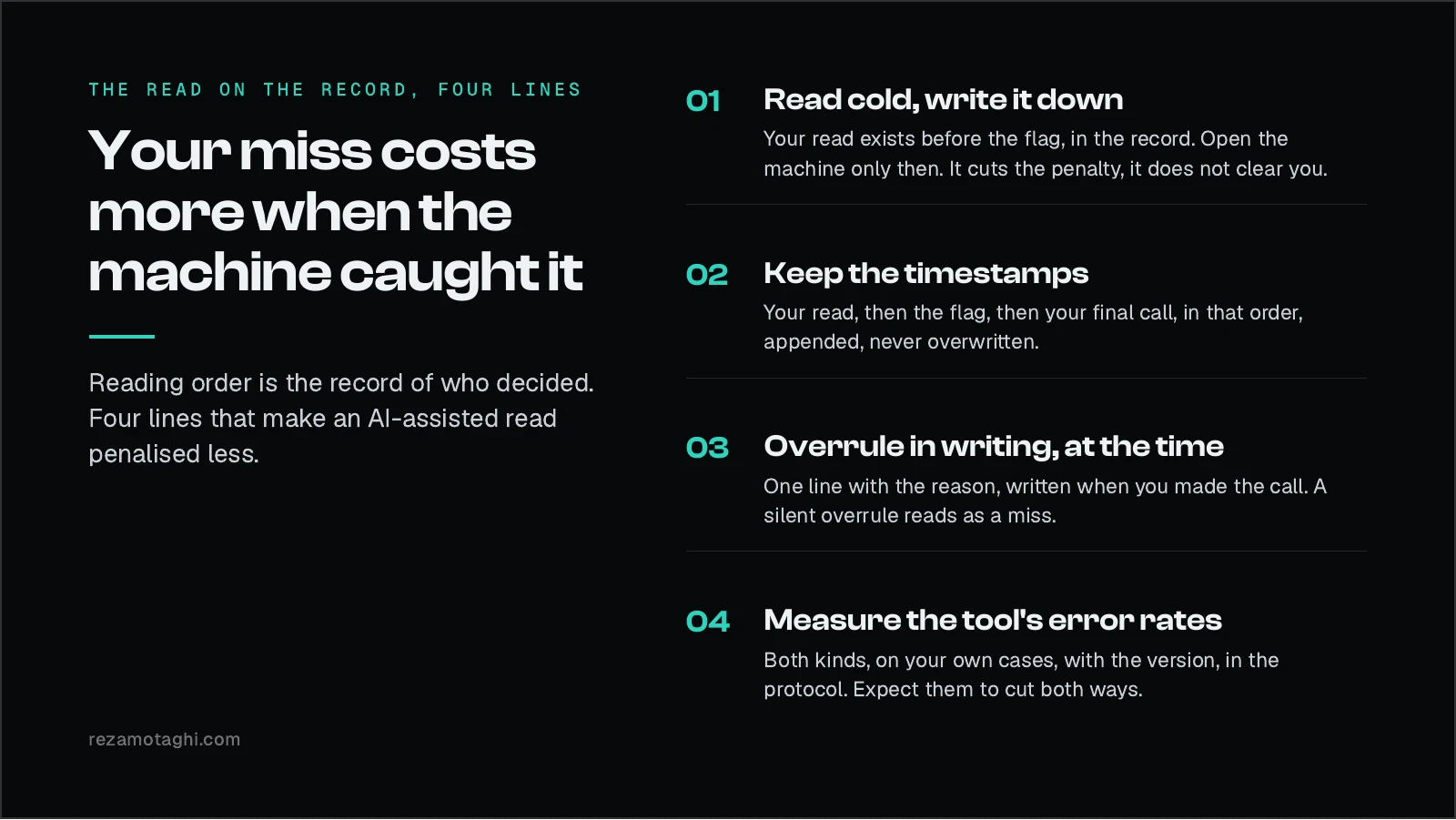
The read on the record, four lines
Four lines, each with its evidence and the case where it does not apply. One of them I changed after reading the evidence against it, and I say which.
1. Read cold, write it down, then open the machine. Your read exists before the flag, in the record. The mock juries above are the evidence: read first, penalised less, not cleared. The craft of the read, and the screening programmes that blind the second reader, are on the cold read. Off-ramp: the written read is a commitment as well as a record. Veterinary radiologists asked to write a first read agreed with the AI less whether it was right or wrong, and rarely revised.13 So the line ends at "then open the machine", and the second look at every disagreement is part of it. One design removes the question. In CBCTScope, the first CBCT viewer with native AI-agent control, the agent moves the camera and no verb returns a finding. There is no flag to read after.
2. Keep the timestamps. Your read, then the flag, then your final call, in that order, appended, never overwritten. The ACR archive rule is the evidence: a preliminary read is kept with its time, and a discrepancy is documented, not erased.9 It is the same discipline as never editing an old label in place. Off-ramp: the tool's own log is not this line. The EU AI Act makes a high-risk system log its events and its deployer keep the logs for at least six months.14 Those logs are the system's. They show when the flag was made, and only your record shows when you read. Where your reporting system already stores the preliminary and the final read as separate versions with their times, the line exists. Check once that it holds the order, and keep no second copy by hand.
3. Overrule in writing, at the time. One line with the reason. A silent overrule reads as a miss. In the second jury study the radiologist read a correct flag and concluded no bleeding, and three in four jurors judged that case against the radiologist.5 The time matters because of hindsight. A reason written at the time is the only account of the read not written by someone who already knew the answer. Off-ramp: the line prices an overrule, it does not protect one. A co-author of both studies put the system effect plainly: if you disagree with the AI and you are wrong, this will be used against you.15 When the only reason you can write is that you did not see it, you have not overruled anything. Go back to the image.
4. Measure the tool's error rates on your own cases, both kinds, with the version, and put them in the protocol. This is the line I changed. My draft said to put the tool's error rate in the protocol so the record shows you knew it. The evidence would not carry that. In the NEJM AI study, jurors in one arm were told the tool's false discovery rate, the share of its flags that were wrong, was 50 percent. For the missed bleed, the plaintiff's share fell from 72.9 to 48.8 percent.3 For the missed cancer the change did not reach significance. And jurors heard the rate inside the vignette. Nothing tested a rate written into a radiologist's protocol.
So the line stays, and it changed shape. Measure both kinds of error, false flags and false silences, on your own cases, because one accuracy number hides which task fails. Write the version beside the rate, because a rate belongs to one version of one tool. Then expect the rates to cut both ways. A record that shows the tool is right more often than you on a task, and that you dismissed it anyway, is not cover. It is the price of the overrule, in your own hand. That is my inference, and no study has tested it. Off-ramp: none for the measuring. In a Nature Medicine study of 140 radiologists, accurate tools raised their performance and poor tools lowered it.16 The rate decides whether the tool belongs in the room at all. That decision lives in the protocol, not the case.
What the lines are not
They are not legal advice, because both studies are mock juries reading a vignette, and a vignette is not a verdict. Three law scholars in the Journal of Nuclear Medicine put the limits plainly.17 Most cases settle, a judge can decide for the physician before trial, and real jurors deliberate under instruction. The authors of the double-read study say the same of their own work.6
They are not proof that reading first is what did it. The double-read study had no arm without AI. Its preprint concedes the effect holds when images are read twice, or at least when the radiologist reads first.18 Reading twice and reading first are tangled in one result, and the authors' own verb is mitigated.
Nor are they proof that a second read makes you safer. Two checks are not twice as safe, and both reads in that study ended on the same wrong answer. What changed was how the miss was judged, not whether it happened.
They are not a claim that AI makes you likelier to be sued. Every vignette starts from harm. The cases where the tool was wrong and you were right never reach a jury. The studies describe how an existing miss is judged, nothing more.
They are not a regulation. The EU AI Act asks providers to build high-risk systems so the overseer can stay aware of automation bias, the pull to over-rely on the output, and override it.19 That duty reaches AI inside medical devices from 2 August 2028.20 No rule I found asks the reader to record the order of reading, so the lines are yours to keep.
What I sign for
Today I build the training data from my own reads, train the model on it, test it on cases it has never seen, and ship tools I read with. My read on those cases is on paper before I open the AI model's. When we disagree, the image decides, and one line with the time says why I stayed or moved. I sign for what I saw, and the record shows when I saw it.
Write the four lines into the protocol under your current tool this week. If line two cannot be filled because the flag was on the screen before you looked, you have learned what the record would have shown. If you sign work a machine also touches, and want a reader who keeps this record, the contact page reaches me directly.
References
Footnotes
-
US Food and Drug Administration. Premarket Approval P970058, M1000 ImageChecker, decision 26 June 1998. Approval order: the system marks regions "to bring them ... to the attention of the radiologist after the initial reading has been completed" (spacing repaired, the FDA record's own typos). https://www.accessdata.fda.gov/scripts/cdrh/cfdocs/cfpma/pma.cfm?id=P970058 ↩
-
US Food and Drug Administration, via eCFR. 21 CFR 892.2090 and 892.2070, version of 1 September 2026. Labelling must describe the intended reading protocol, and the device is not a replacement for the clinician's review. https://www.ecfr.gov/api/versioner/v1/full/2026-09-01/title-21.xml?part=892§ion=892.2090 ↩
-
Bernstein MH, Sheppard B, Bruno MA, Lay PS, Baird GL. Randomized study of the impact of AI on perceived legal liability for radiologists. NEJM AI 2025, 2(6). 1,334 US adults, two vignettes, five conditions. Jurors sided with the plaintiff 72.9% (brain bleed) and 78.7% (cancer) when AI caught the miss, against 56.3% and 65.2% with no AI. A disclosed 50% false discovery rate lowered the share to 48.8% in the brain-bleed vignette (P=0.001) and not significantly in the cancer vignette (73.1%, P=0.20). https://doi.org/10.1056/AIoa2400785 (abstract read at https://ctisus.com/learning/journalclub/344635) ↩ ↩2
-
2 Minute Medicine. Juror perception of radiologist liability can be affected by artificial intelligence (AI) use in diagnosis. Summary of Bernstein et al., NEJM AI, 2025. AI agree against no AI: 50.0% vs 56.3% (P=0.33) brain bleed, 63.5% vs 65.2% (P=0.77) cancer. https://www.2minutemedicine.com/juror-perception-of-radiologist-liability-can-be-affected-by-artificial-intelligence-ai-use-in-diagnosis ↩
-
Bernstein MH, Sheppard B, Bruno MA, Lay PS, Baird GL. The radiologist-AI workflow and the risk of medical malpractice claims. Nature Health 2026, 1(4):386-389. Randomised preregistered mock-jury study (n = 282): 74.7% sided with the plaintiff after a single read with AI feedback against 52.9% after a read without AI and then with it (P = 0.0002, odds ratio 2.6), on a missed brain bleed the AI had flagged. https://doi.org/10.1038/s44360-026-00085-2 ↩ ↩2
-
McCrear S. AI double reads may reduce radiologist malpractice liability. AJMC, 11 March 2026. Counts 106 of 142 and 74 of 140, the identical determination in both reads, and the authors' limits: generalizability, real-world outcomes, and the unknown effect when the AI also misses. https://www.ajmc.com/view/ai-double-reads-may-reduce-radiologist-malpractice-liability ↩ ↩2
-
Schill HM, Gray SM, Brady TF. Visual hindsight bias for abnormal mammograms in radiologists. Journal of Medical Imaging 2023, 10(S1):S11910. N = 40 experienced readers, AUC 0.60 against 0.55 (p = 0.005) at maximum noise after seeing the clear image first. The authors note that a second radiologist who knows the finding reviews the image in a lawsuit and may bias the jury. https://doi.org/10.1117/1.JMI.10.S1.S11910 ↩
-
Caplan RA, Posner KL, Cheney FW. Effect of outcome on physician judgments of appropriateness of care. JAMA 1991, 265(15):1957-60. 112 anesthesiologists, 21 cases. Appropriate-care ratings fell 31 percentage points when identical care ended in permanent rather than temporary injury. https://pubmed.ncbi.nlm.nih.gov/2008024/ ↩
-
American College of Radiology. ACR Practice Parameter for Communication of Diagnostic Imaging Findings, revised 2025. The final report is the definitive documentation. Preliminary reports are archived with recipient, date and time because clinical decisions may have been based on them, and discrepancies are documented in the final report. The ultimate judgment rests with the practitioner, who may document why an approach differs from the guidance. Not a legal standard of care. https://gravitas.acr.org/PPTS/DownloadPreviewDocument?DocId=74 ↩ ↩2 ↩3
-
Mata v. Avianca, Inc., No. 22-cv-1461 (PKC), Opinion and Order on Sanctions (S.D.N.Y. 22 June 2023). Nothing inherently improper about a reliable AI tool, existing rules impose a gatekeeping role on attorneys, the respondents stood by the fake opinions after they were questioned, $5,000 penalty. https://storage.courtlistener.com/recap/gov.uscourts.nysd.575368/gov.uscourts.nysd.575368.54.0.pdf ↩
-
National Society of Professional Engineers, Board of Ethical Review. Use of artificial intelligence in engineering practice, Case 24-2. Reviewing after preparation without involvement in the design does not satisfy Responsible Charge, and failing to keep it before sealing AI-drafted work was unethical. https://www.nspe.org/sites/default/files/24-2-Artificial-Intelligence-in-Engineering-Practice.pdf ↩
-
Charlotin D. AI Hallucination Cases Database, updated 30 September 2026. 2,096 decisions: 1,208 self-represented litigants, 830 lawyers, 33 judges, 1,431 in the USA. https://www.damiencharlotin.com/hallucinations/ ↩
-
Fogliato R, Chappidi S, Lungren M, Fitzke M, Parkinson M, Wilson D, Fisher P, Horvitz E, Inkpen K. Who goes first? Influences of human-AI workflow on decision making in clinical imaging. ACM FAccT, 2022. 19 veterinary radiologists. A written provisional read lowered agreement with the AI whether or not it was right, the two-step group rarely revised, and the step added no time. https://arxiv.org/abs/2205.09696 ↩
-
European Union. Regulation (EU) 2024/1689 (Artificial Intelligence Act), Articles 12(1), 26(2) and 26(6). High-risk systems must log events automatically. Deployers assign competent oversight and keep the logs for at least six months. https://ai-act-service-desk.ec.europa.eu/en/ai-act/article-26 ↩
-
Penn State Health News, 18 March 2026, quoting co-author Baird GL: "If you disagree with AI and you're wrong, this will be used against you." Also Brown University medical school news, 28 July 2025, and Payne M, AuntMinnie, 3 June 2025, corroborating the percentages. https://pennstatehealthnews.org/2026/03/how-ai-is-integrated-into-clinical-workflow-lowers-medical-liability-perception/ ↩
-
Yu F et al. Heterogeneity and predictors of the effects of AI assistance on radiologists. Nature Medicine, 2024, as reported by Harvard Medical School, 19 March 2024. 140 radiologists, 324 cases. The effect of AI assistance varied by reader, accurate tools helped, poor tools hurt. https://hms.harvard.edu/news/does-ai-help-or-hurt-human-radiologists-performance-depends-doctor ↩
-
Price WN, Gerke S, Cohen IG. How much can potential jurors tell us about liability for medical artificial intelligence? Journal of Nuclear Medicine 2021, 62:15-16. Most cases settle, judges can decide before trial, real jurors deliberate under instruction. https://jnm.snmjournals.org/content/62/1/15 ↩
-
Bernstein MH, Sheppard B, Bruno MA, Lay PS, Baird GL. Radiologist-AI workflow can be modified to reduce the risk of medical malpractice claims. medRxiv preprint, posted 16 June 2025. Full vignette and the concession that the penalty is mitigated "when images are interpreted twice, or at least if a radiologist gives an interpretation before AI is used". https://doi.org/10.1101/2025.06.14.25329278 ↩
-
European Union. Regulation (EU) 2024/1689 (Artificial Intelligence Act), Article 14(4)(b) and (d). Providers must enable overseers to remain aware of automation bias and to disregard, override or reverse the output. https://ai-act-service-desk.ec.europa.eu/en/ai-act/article-14 ↩
-
European Commission. AI Omnibus enters into force (Regulation (EU) 2026/1744 of 8 July 2026, Official Journal 24 July 2026). High-risk rules apply from 2 December 2027 (Annex III) and 2 August 2028 (Annex I products, which include AI-enabled medical devices per Sidley, 22 June 2026). https://digital-strategy.ec.europa.eu/en/news/ai-omnibus-enters-force ↩