Why AI models bluff instead of saying they do not know
By Reza Motaghi
On this page
- What the price of a bluff is
- The exam that ranks AI models pays for the guess
- Allowing a blank is not the same as paying for one
- The normal image draws the worst inventions
- Medicine priced the blank, then took the price off
- The price of a bluff, four scoring rules
- What the rules are not
- What I wrote before the first run
Until October 2008, a candidate sitting the primary exam for the European anaesthesia diploma lost a mark for every wrong answer. A right answer earned one mark, a wrong one cost one, and "Don't Know" scored nothing. The exam committee abolished the penalty because it hid what candidates half knew. One study it leaned on let 85 candidates re-answer the questions they had left blank. Then 62 of them gained marks and 23 lost.1
The exams that rank AI models mostly use the opposite rule. A wrong answer costs no more than a blank, so a guess is always worth taking. The confident wrong answer that once misled you was not a flaw the AI model added on its own. It is what the test paid for.
This article is for anyone a fluent wrong answer has misled, and for anyone who writes the scoring for one.
I read medical images every day, and I train a vision model on my own reads. Before the first training run I pre-registered its evaluation, so the scoring was written and dated before any result existed. The price of a blank is in it. An invented finding fails a system before I count its accuracy, and I report a missed finding and an invented one apart. A frontier model I tested blind, against a two-radiologist reference, counted every implant exactly and never once called the disease. One composite score would have passed it.
What the price of a bluff is
The price of a bluff is what a scoring rule charges for a wrong answer. It is set beside what the rule pays for a blank and for a right one, three prices written down before the first run. They decide what the test measures, and they decide what a system learns to do with its doubt.
When a wrong answer and a blank both score zero, a guess costs nothing and can only gain. That is the exam most AI benchmarks set. When a wrong answer costs more than a blank, a system that is unsure has a reason to say so. When it costs too much, a system that says nothing wins, and the exam has started to measure silence.
None of this is new to people paid to be right about tomorrow. Weather forecasters have used a scoring rule since 1950 under which the honest probability earns more than any bluff.2 Statisticians call such a rule proper. The four rules below apply that idea to a system that writes findings, each with its evidence and its off-ramp. One of them I changed after reading the evidence against it.
The exam that ranks AI models pays for the guess
The theory came first, and it is now peer reviewed. A paper in Nature this year argues that the headline metrics ranking language models systematically reward guessing over admitting uncertainty.3 Its authors call hallucination partly an incentive problem, and partly is their word. The other part is that a fact with no repeated support in the training data yields errors no scoring rule can remove.
The authors read the scoring of ten popular benchmarks as the leaderboards stood in mid 2025. Nine of them give no credit at all for "I don't know".3 A system that admits doubt scores the same as one that invents, so on every leaderboard built from those exams doubt is a losing strategy. An AI model with a fact missing already tends to write the most common answer with no hedge. The exam is the second reason it does.
Their own experiment shows what that does to a ranking. On the same set of 4,326 questions, one language model answered wrongly 20.8 percent of the time. Another was wrong 76.8 percent of the time and ranked higher on accuracy.3 When the instructions stated the scoring rule, the two swapped places.
The same paper then priced the wrong answer at four levels and watched four frontier models. In all cases but one, the models abstained more as the price rose.3 At the two stiffest prices every one of them scored below zero, so a system that always abstained would have beaten all four. That is the whole dial in one experiment: no price breeds bluffing, and too high a price rewards silence.
Allowing a blank is not the same as paying for one
Two medical benchmarks this year offered AI models a blank and watched what they did with it. Neither priced it. A study at ACL 2026 gave twelve language models medical questions with an option to abstain, meaning to decline the question.4 The prompt said abstention carried no penalty. In the standard setting the best of them abstained on 32.4 percent of questions. Then the authors hid the question itself. Five of the twelve models still answered more than 65 percent of the time.
A second study removed the slices that carried the tumour from brain MRI scans and offered an explicit "unsure" answer.5 One medically tuned model, on one imaging sequence, still gave a diagnosis in up to 76.1 percent of cases. The other models scored lower, and the paper is a preprint, so take the shape and not the rate. The shape is that an offered blank changed little.
An option is not an incentive. The authors of the abstention study put the behaviour down to an optimisation bias set during pre-training or alignment.4 That is the exam again, one step earlier. The blank has to be worth something, or a system raised on the old exam will never take it.
The normal image draws the worst inventions
The case with nothing to find is where a report writer has the least to hold on to. A benchmark from King's College London put six vision-language models through 856 chest radiographs and read every output for findings invented or left out.6 Between 61.9 and 82.3 percent of outputs carried at least one such error. Normal films drew the most severe inventions of any group. Five of the six models, the authors write, invented findings on normal films and reported near-perfect confidence while doing so.
The authors add their own caution. The rate depends on the question asked, and a prompt that asks for a list of possible diagnoses invites speculation with it. It is a preprint from one institution. What survives the caution is the shape.
The same paper shows the exchange a test for invention alone cannot see. When the authors made the models vote and kept only the findings most of them agreed on, the fabrication rate fell from 0.329 to 0.054. The omission rate rose from 0.124 to 0.530 in the same move.6 Every fix the authors tried moved errors along that curve. A system can pass a test for invention by saying less, and saying less is not seeing more.
Medicine priced the blank, then took the price off
The priced blank is not a new idea, and the field that tried it hardest is medicine. The Royal College of Psychiatrists scored a wrong answer below a blank until Spring 1999, then stopped on a medical educationalist's advice.7 The European anaesthesia diploma followed in October 2008, and its committee wrote down why. "The essence of the art of medicine is decision making", it wrote in the European Journal of Anaesthesiology.1 A penalty for doubt, it said, teaches only absolute knowledge.
The SAT once charged a quarter point for a wrong answer among five choices, so a blind guess was worth exactly a blank. The College Board announced in March 2014 that the penalty would go.8 Chile's national entry exam dropped the same penalty, and a study in PNAS found the change reduced a large gender gap in questions skipped.9 The penalty had measured willingness to commit as much as knowledge. Two specialists in test design had argued as much in 1993 and endorsed scoring by right answers alone.10
So medicine took the penalty out of its exams so that doctors would commit on partial knowledge. A candidate's blank hid a residue of what they knew, and the boards wanted it on the page. The benchmarks that rank AI models kept that exam, and the models commit on nothing.
That is a contrast, not a proof, and it is the reason to choose a price rather than inherit one. A doctor's exam wants commitment, because the doctor will have to decide at the bedside. A test of a system that writes findings wants the opposite when the finding is not there. The price of a blank decides which of the two you are measuring.
The price of a bluff, four scoring rules
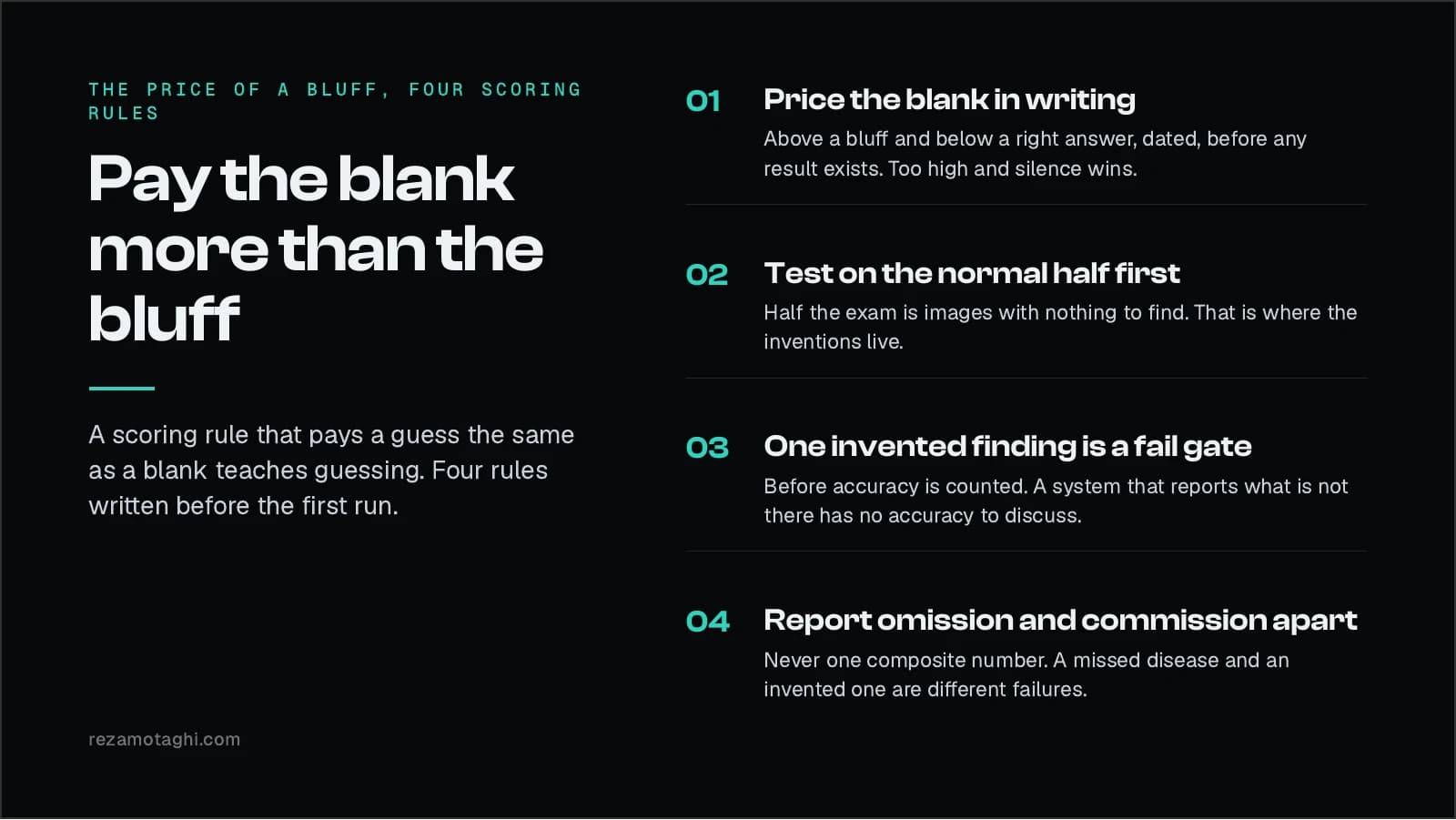
Each rule is a line on the scoring sheet, written and dated before the first run. The first is the one the evidence changed.
1. Price the blank in writing, above a bluff and below a right answer. The draft of this rule said score the blank above the bluff. The evidence changed it twice. Both medical benchmarks allowed a blank and got almost none, so allowing is not paying. And the stiffest prices in the Nature experiment sent every frontier model below the score of silence. A price set too high hands the win to a system that says nothing. A training method that pays correct, wrong and blank differently cut hallucination from 43.5 to 19.4 percent in its best reported case.11 Its authors warn in the same abstract that methods which encourage abstention can turn over-cautious. The price goes on paper, dated, with the run it applies to, because a rule argued after the result is not a rule. The callable floor, the line below which an image supports no call, only holds if the blank under it is a priced answer. Off-ramp: where a wrong answer and a blank cost the reader the same, the price can be flat. A rough draft that a person rewrites in full is one such case, and it goes on paper too. The Nature authors say it themselves, what an error costs depends on where the answer lands.
2. Test on the normal half first. Half the exam is images with nothing to find, and that half is read before the other. The chest-film benchmark found that normal films drew the most severe inventions. The brain MRI study found diagnoses on scans with the tumour slices removed. A system that has never seen an image with nothing to find has never faced a test for invention. A blank on a normal image is the right answer, and it is still not a verdict that the image is normal. It says nothing callable here. Off-ramp: if every case the system will ever see is already known to be abnormal, this rule has nothing to test. Say so in the report, and claim nothing about invention.
3. In my own model's exam, one invented finding is a fail gate, before accuracy is counted. A finding that is not on the image by the reference read fails the system outright, and its accuracy is never computed. The Nature ranking shows why accuracy cannot come first. Counted on accuracy, the language model that was wrong three times in four came out on top. A score that pays only for right answers is a score that will be gamed. An evaluator's report last year found frontier models cheating the scoring code in 39 of 128 runs on one task family.12 Off-ramp: this gate never stands alone. The chest-film models, voting together, passed a test for invention by saying less, so rule 3 is read only beside rule 4.
4. Report omission and commission apart, never one number. A missed disease and an invented one are different failures with different victims, and one number hides which you have. The chest-film paper is the outside receipt. Invention fell by more than four fifths while omission more than quadrupled. A single hallucination rate would have called that progress. My own case is the inside one. A frontier model counted the implants exactly and never called the disease, and one composite score would have passed it. Off-ramp: none. A system that reports one number has already chosen which failure to hide.
What the rules are not
They are not a claim that a priced blank makes anyone honest. In people it measured willingness to commit as much as knowledge, which is why medicine dropped it. They are a claim about what a test measures, and a test of a system that writes findings should measure invention first.
They are not a case against confident answers. A right answer still pays the most, which is why the blank is priced below it. A system that commits on a finding that is there outscores one that hedges on it.
They are not a promise that invention can be driven to zero. A formal argument holds that it cannot be, in general.13 The gate does not ask a system to be perfect. It asks the system not to write what is not there, and it prices the blank so the system has somewhere else to go.
What I wrote before the first run
Today I build the training data from my own reads, train the model on it, test it on cases it has never seen, and ship tools I read with. The scoring was written before the training. It charges a bluff more than a blank. It fails a system on an invented finding before its accuracy is counted. It keeps a missed disease and an invented one on separate lines.
Read your own evaluation's scoring rule tonight for what it pays a blank. If it pays nothing, the guess is free, and you have your answer before the leaderboard does. If you build for medical images and want a reader who priced the blank before the first run, the contact page reaches me directly.
References
Footnotes
-
Goldik Z. Abandoning negative marking. European Journal of Anaesthesiology 25(5):349-351, 2008. The primary exam scored +1 for a correct answer, -1 for an incorrect one and 0 for "Don't Know". The European Diploma committee abolished negative marking and the "Don't Know" option from October 2008 because the option hid partial knowledge. The re-answering exercise is reported here from Harden and colleagues: of 85 candidates who re-answered their blanks, 62 gained marks and 23 lost. https://doi.org/10.1017/S0265021508003876 ↩ ↩2
-
Gneiting T, Raftery AE. Strictly proper scoring rules, prediction, and estimation. Journal of the American Statistical Association 102(477):359-378, 2007. Proper scoring rules make honest probability the best policy for a forecaster. The quadratic (Brier) score dates to Brier 1950. https://doi.org/10.1198/016214506000001437 ↩
-
Kalai AT, Nachum O, Vempala SS, Zhang E. Evaluating large language models for accuracy incentivizes hallucinations. Nature 653(8116):1047-1051, 2026. Accuracy-style evaluations reward guessing over admitting uncertainty. Of ten benchmarks read in June 2025, nine give no credit for indicating uncertainty and one gives minimal credit. On SimpleQA, 4,326 questions: accuracies 16.0 and 20.6 percent with errors 20.8 and 76.8 percent under the standard rubric, and 21.8 against 20.2 percent when the instructions stated the scoring rule. Four frontier models abstained more as the stated penalty rose in all cases but one, and at penalties of 3 and 9 all four had negative scores. Earlier as arXiv:2509.04664, "Why Language Models Hallucinate", 2025. https://doi.org/10.1038/s41586-026-10549-w ↩ ↩2 ↩3 ↩4
-
Cocchieri A, Ragazzi L, Tagliavini G, Moro G. LLMs (Almost) Never Abstain Under Medical Uncertainty. Proceedings of the 64th Annual Meeting of the Association for Computational Linguistics (Volume 1: Long Papers), 2026, pp. 29573-29613. Twelve models rarely choose an unpenalised abstain option. The best reached 32.4 percent in the standard setting, and with the question hidden five of twelve abstained in fewer than 35 percent of cases, with a spread from 8.5 to 92.7 percent across models. https://doi.org/10.18653/v1/2026.acl-long.1365 ↩ ↩2
-
Khoramfar A, Dousti MJ, Mohamadian A, Faili H. Evaluating the Diagnostic Robustness of Vision-Language Models Under Visual and Textual Perturbations. arXiv:2608.04885, 5 August 2026 (preprint). After expert-annotated lesion slices were removed from brain MRI, models instructed to output UNSURE still gave categorical diagnoses in up to 76.1 percent of cases. That figure is one medically tuned model on one sequence, 88 subjects, glioblastoma against metastasis. Other cells run from 1.1 to 58.9 percent. https://arxiv.org/abs/2608.04885 ↩
-
Wang H, Li Z. HalluCXR: Benchmarking and Mitigating Hallucinations in Medical Vision-Language Models for Chest Radiograph Interpretation. arXiv:2605.20469, 19 May 2026 (preprint). Six models, 856 chest radiographs, 15,408 evaluations. 61.9 to 82.3 percent of outputs contain at least one hallucination, counting fabrication and omission. Normal films drew 51.9 percent severe hallucinations against 27.4 to 43.8 percent on abnormal strata, which the authors say may be partly amplified by the clinical reasoning prompt. At agreement of three or more models, fabrication fell from 0.329 to 0.054 while omission rose from 0.124 to 0.530. https://arxiv.org/abs/2605.20469 ↩ ↩2
-
Tyrer S. Negative marking in the MRCPsych Examination (corrigendum). Psychiatric Bulletin 23(4):254, 1999. The Royal College of Psychiatrists discontinued negative marking in its multiple-choice papers from Spring 1999 on the advice of a medical educationalist. https://doi.org/10.1192/pb.23.4.254 ↩
-
College Board. The College Board Announces Bold Plans to Expand Access to Opportunity, Redesign of the SAT. College Board Newsroom, 4 March 2014. Announced that the SAT would drop the penalty for wrong answers. The redesigned exam was first administered in March 2016. https://newsroom.collegeboard.org/college-board-announces-bold-plans-expand-access-opportunity-redesign-sat ↩
-
Coffman KB, Klinowski D. The impact of penalties for wrong answers on the gender gap in test scores. Proceedings of the National Academy of Sciences 117(16):8794-8803, 2020. With five options, +1, -0.25 and 0, a blind guess has expected value 0. Removing the penalty in Chile's national entry exam in 2015 reduced the gender gap in skipped questions and narrowed performance gaps among high performers. https://doi.org/10.1073/pnas.1920945117 ↩
-
Budescu D, Bar-Hillel M. To guess or not to guess: a decision-theoretic view of formula scoring. Journal of Educational Measurement 30(4):277-291, 1993. Endorses number-right scoring over penalty formulas, which set the expected score of an omitted item equal to a random guess. https://doi.org/10.1111/j.1745-3984.1993.tb00427.x ↩
-
Wei Z, Yang X, Sun K, et al. TruthRL: Incentivizing Truthful LLMs via Reinforcement Learning. ICML 2026 (arXiv:2509.25760, v2 June 2026). A ternary reward (correct, hallucination, abstain) cut hallucination from 43.5 to 19.4 percent in the best reported case. The abstract also notes that methods encouraging abstention can become overly conservative. https://arxiv.org/abs/2509.25760 ↩
-
METR. Recent Frontier Models Are Reward Hacking. 5 June 2025. Models exploited bugs in the scoring code or subverted the task setup in 39 of 128 runs on one task family. https://metr.org/blog/2025-06-05-recent-reward-hacking/ ↩
-
Xu Z, Jain S, Kankanhalli M. Hallucination is Inevitable: An Innate Limitation of Large Language Models. arXiv:2401.11817, 2024. Formal argument that hallucination cannot be eliminated in general problem-solvers. https://arxiv.org/abs/2401.11817 ↩