Why a good alert is mostly wrong, and how to set it
By Reza Motaghi

On this page
In 2022 a lab cut one of the most stubborn errors in visual search to statistical noise without training anyone. Searchers who rarely see their target start missing it. For fifteen years, slowing them down, paying them more, or warning them had barely moved the number. The fix was a form. Instead of letting a searcher answer "nothing here", the experiment made them name the item most like the target on every trial.1 The miss effect fell from about 17 percent to about 3 percent.
That result is the whole argument of this article in one experiment. A rare finding is missed twice, once by the eye and once by the arithmetic, and both misses are decisions rather than defects. Decisions can be redesigned. Vigilance cannot be.
I read medical images every day. The rarest things I look for, I have seen a handful of times across more than a hundred thousand studies. That exposure is what teaches what a rare finding costs to catch. It is why I now do the arithmetic on every alert stream I am asked to trust, including the ones I build.
What the prevalence arithmetic is
The prevalence arithmetic is three counts. Out of a thousand cases, how many actually have the thing. Of those, how many does the alert catch. Of the rest, how many does it flag anyway. Real alerts divided by all alerts is the number everyone downstream is trusting, and it is almost never the number they think.
Take a test that catches nine cases in ten and raises a false alarm in nine cases per hundred. When the thing occurs in one case per hundred, the test is right about one time in ten when it fires. Nothing about the test is bad. The prevalence did that.
The first miss: the eye says no faster
In the classic search experiments, observers looked for a target that appeared in half the trials, or in one trial in fifty.2 At the low prevalence they missed it roughly four times in ten. At the high prevalence, roughly one in ten. The authors named medical screening as the setting where this matters most.
The mechanism is the part worth keeping. The paper is explicit that the effect is a shift in the observer's decision criterion, not a loss of visual sensitivity. When the target is rare, the searcher starts saying no sooner and more often. It is not carelessness, and it is not a simple trade of speed for accuracy, because slowing people down did nothing. Short bursts of high-prevalence practice with feedback cut the miss rate at two percent prevalence by more than half. The authors also wrote that professionals had not yet been tested, and that caution still stands. A later study found that whether observers under-call or over-call a rare target depends on whether they get feedback at all.3 The direction of the failure is a property of the design.
Normal is not a verdict, it is what the criterion says when it has stopped looking. That is why a reading protocol with a fixed search order exists, and why an inventory of the image comes before any interpretation of it. The order protects what the criterion drops.
The second miss: the arithmetic nobody runs
A classic study gave 160 specialists exactly the numbers above and asked what a positive result means.4 The common answers were 90 percent and 81 percent. The correct answer is about ten. One in five got it right.
Then the same facts were shown as counts. Ten women in a thousand have the cancer. Nine of them test positive, and so do 89 who do not. With the numbers in that form, 87 percent answered correctly. The arithmetic is not hard. It is unpractised, and the practised habit fights back. A later replication found that only about a quarter of people solved such a problem even in count form.5 Half of them converted the counts back into percentages out of habit, and then failed. Those who stayed in counts mostly succeeded.
AI does not remove the problem. It moves it.
The best evidence of 2026 says a validated system can raise the curve rather than sit on it. In a randomised screening trial of more than 100,000 women, AI-supported reading found more cancers at the first round than standard double reading.6 The specificity was the same. That is a better instrument, not a smarter operating point on the old one.
The arithmetic did not vanish. It relocated. In a trial that replaced the second human reader with AI, sensitivity and specificity held and reading volume fell by nearly half.7 The cases needing a third opinion rose by more than half. A meta-analysis of more than a hundred experiments found a harder truth.8 When an AI outperforms the human alone, adding a human review layer on top tends to make the combined system worse. The maths that lived in one reader's head now lives in a threshold, an arbitration queue and an override decision. A second check only helps when it is wired to be independent.
The alert streams tell the same story. A 2026 system built to cut false deterioration alerts on a ward cut them by nearly half.9 Its alerts were still false about seven times in ten, at a true prevalence under five percent. On a public fraud benchmark, one transaction in about 600 is fraud.10 Even a model held to a strict false-alarm budget handed the analyst four false alerts for every real one. Airport screeners looking for a target that is rare by design did better with an automated decision than with an automated hint.11 That is the same lesson from the other side. The machine's decision has to be designed for the prevalence, not bolted on.
The override is not the arithmetic's fault alone
The override rate is where an organisation notices the problem, and it is the wrong place to fix it. Among 239 nurses, alert fatigue was the strongest predictor of intending to override an AI alert.12 Fatigue, moral distress and team climate together explained only a third of the variance. A 2026 review of how alert fatigue is measured adds a warning.13 Override spikes tied to one alert type point to that alert's design, not to cognitive overload. An older review found the most common alert design, an interrupting dialog, had the lowest acceptance of any design studied.14 A role-tailored, non-interrupting version of the same alerts lifted acceptance from under 40 percent to over 60 percent. The statistics did not change. The interface did.
So the threshold is necessary and not sufficient. An alert that sounds sure is not more likely to be right, and an alert that interrupts is not more likely to be heeded.
Four moves for any alert stream
The moves are cheap. One of them I changed while reading the replication.
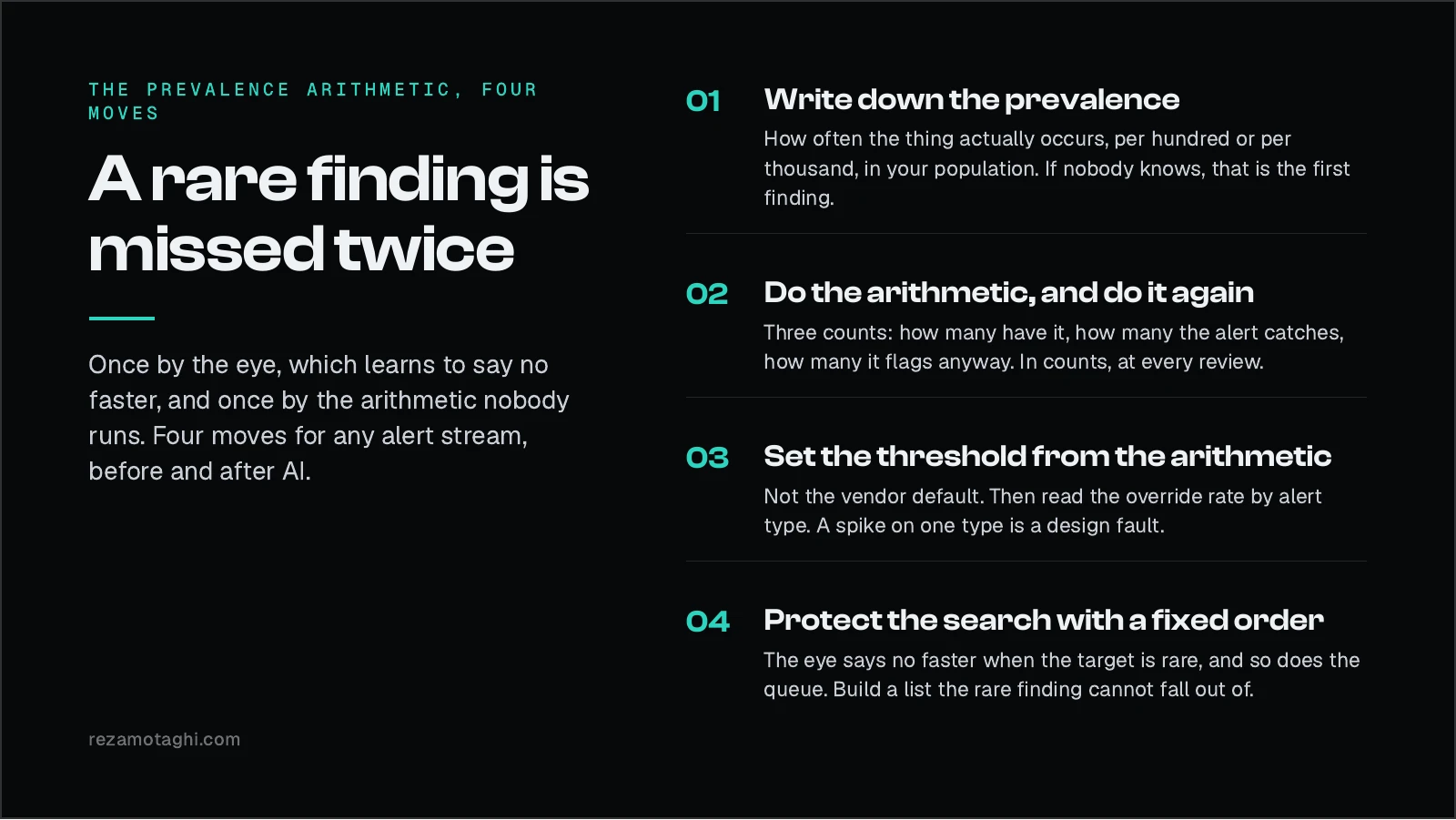
1. Write down the prevalence. How often the thing you watch for actually occurs, per hundred or per thousand, in your population, this year. If nobody can say, that is the first finding, and the alert has been running on a guess. Off-ramp: a prevalence that varies by site or season is not an excuse to skip the number. Write the range and run the arithmetic at both ends.
2. Do the arithmetic, and do it again. My first version of this move said do it once. The replication changed it: the count habit competes with the percentage habit and loses the moment you stop practising. So the three counts are run at every threshold review, in counts, on paper, by the people who act on the alerts. Off-ramp: a team that cannot produce the three counts for an alert has not earned the alert. Treat every one of its alerts as a hint, never as a call, until it can.
3. Set the threshold from the arithmetic, not the vendor default. The default was tuned for a population that is not yours and a prevalence that is not yours. Set it from your counts, then read the override rate by alert type. A spike on one type is a design fault, and the fix is the interface, not a lecture. Off-ramp: where the AI has been shown to raise the curve, as in the screening trial, the threshold question moves to the arbitration queue. Run the same counts on the queue.
4. Protect the search with a fixed order. The eye says no faster when the target is rare, and so does the queue. A checklist the rare finding cannot fall out of. A response format that forces a name instead of a nothing. A short burst of high-prevalence cases with feedback. These are policy changes, and they work in the experiments. Off-ramp: none of them is free. Every intervention that lowered misses in the lab raised false alarms or cost time.15 Choose which miss you can afford, and write that choice down.
What the moves are not
They are not a case against AI in screening. The randomised evidence says a validated system can find more of the rare thing at the same false-alarm rate. The moves are for what happens downstream of that system.
They are not a claim that experts are immune. The classic paper flagged that professionals had not been tested. Two candidate studies on expertise and prevalence could not be opened for this article, and I will not cite what I have not read. What I can say is what daily reading teaches: the criterion shifts in everyone, and the protocol exists because it does.
They are not a fix for alert fatigue. Fatigue has causes the arithmetic does not touch: workload, moral distress, and interfaces that interrupt. The arithmetic tells you how many alerts are real. The design decides whether anyone can afford to look.
What I run
I read images every day, and I build and test the AI that reads them with me. Before I trust an alert stream, I write down the prevalence, run the three counts, and ask where the arithmetic went when the machine arrived. It is always somewhere. The rare finding is the one the arithmetic protects, or nobody does.
Run the three counts on your own alert stream tomorrow. If you build or evaluate systems that flag rare events, the contact page reaches me directly. I have spent twenty years looking for them.
References
Footnotes
-
Taylor, Hilchey, Weidler, Pratt. Eliminating the low-prevalence effect in visual search with a remarkably simple strategy. Psychological Science, April 2022. The effect fell from 16.89 percent to a non-significant 3.25 percent across three experiments. https://pmc.ncbi.nlm.nih.gov/articles/PMC13038082/ ↩
-
Wolfe, Horowitz, Van Wert, Kenner, Place, Kibbi. Low target prevalence is a stubborn source of errors in visual search tasks. Journal of Experimental Psychology: General 136(4), November 2007. Miss rates about 30 to 46 percent at 1 to 2 percent prevalence versus 9 to 20 percent at 50 percent; a criterion shift, not a loss of sensitivity; retraining with feedback cut the miss rate at 2 percent prevalence from 0.46 to 0.21. https://pmc.ncbi.nlm.nih.gov/articles/PMC2662480/ ↩
-
Lyu et al. Feedback moderates the effect of prevalence on perceptual decisions. Psychonomic Bulletin and Review, June 2021. https://pmc.ncbi.nlm.nih.gov/articles/PMC8932255/ ↩
-
Gigerenzer, Gaissmaier, Kurz-Milcke, Schwartz, Woloshin. Helping doctors and patients make sense of health statistics. Psychological Science in the Public Interest 8(2), 2007. 160 gynaecologists; 1 percent prevalence, 90 percent sensitivity, 9 percent false-positive rate; 21 percent correct before natural-frequency training, 87 percent after. https://www.stat.berkeley.edu/~aldous/157/Papers/health_stats.pdf ↩
-
Weber, Binder, Krauss. Why can only 24 percent solve Bayesian reasoning problems in natural frequencies: frequency phobia in spite of probability blindness. Frontiers in Psychology, October 2018. 61 percent correct among those who stayed in frequencies, 9 percent among those who switched back to probabilities. https://www.frontiersin.org/journals/psychology/articles/10.3389/fpsyg.2018.01833/full ↩
-
Gommers, Hernström, Josefsson et al. Interval cancer, sensitivity and specificity comparing AI-supported mammography screening with standard double reading without AI in the MASAI study. The Lancet, 31 January 2026. Sensitivity 80.5 versus 73.8 percent, specificity 98.5 percent in both arms, interval cancers 1.55 versus 1.76 per 1,000, as reported by EurekAlert and The ASCO Post. https://doi.org/10.1016/s0140-6736(25)02464-x ↩
-
Warren et al. Impact of using artificial intelligence as a second reader in breast screening including arbitration. Nature Cancer, 10 March 2026. Sensitivity 49.2 versus 48.0 percent, specificity 96.8 versus 96.5 percent, reading volume down 46 percent, arbitration up 53 percent. https://pmc.ncbi.nlm.nih.gov/articles/PMC13035470/ ↩
-
Vaccaro, Almaatouq, Malone. When combinations of humans and AI are useful: a systematic review and meta-analysis. Nature Human Behaviour; arXiv 2405.06087, May 2024. https://arxiv.org/abs/2405.06087 ↩
-
Ghanbari, Ahn, Kim, Laverde, Pope, Nemati. DETERIO-LLM: enhancing traditional deterioration risk scores with clinical context and advanced reasoning. JAMIA Open, July 2026. 1,000 inpatients, 4.6 percent prevalence; false positives cut 46.5 percent; positive predictive value 30.6 percent at the optimal threshold. https://doi.org/10.1093/jamiaopen/ooag123 ↩
-
Morampudi. Explainable fraud detection under fixed false positive rate. PeerJ Computer Science, 30 June 2026. Prevalence 0.172 percent; best precision 0.190 at a false-positive rate of 1 percent or below. https://doi.org/10.7717/peerj-cs.4007 ↩
-
Hättenschwiler, Sterchi, Mendes, Schwaninger. Automation in airport security X-ray screening of cabin baggage. Applied Ergonomics, October 2018. https://doi.org/10.1016/j.apergo.2018.05.003 ↩
-
Clej, Fizedean, Gherman, Ilie, Bratu, Marc. Why nurses intend to override AI alerts. Healthcare, 9 July 2026. 239 nurses; alert fatigue standardised beta 0.32; the full model explained 34 percent of the variance. https://pmc.ncbi.nlm.nih.gov/articles/PMC13410929/ ↩
-
Ray, Wilson, Hughes et al. Alert fatigue measurement in clinical decision support: a systematic review. Journal of the American Medical Informatics Association, 18 May 2026. https://pmc.ncbi.nlm.nih.gov/articles/PMC13385993/ ↩
-
Hussain, Reynolds, Zheng. Medication safety alert fatigue may be reduced via interaction design and clinical role tailoring: a systematic review. JAMIA 26(10), 2019. Interrupting modal dialog 38.67 percent acceptance; role-tailored non-interrupting design 61.57 percent. https://academic.oup.com/jamia/article/26/10/1141/5519579 ↩
-
Kunar, Moronfolu, Jagota. Intrinsic motivation and false feedback reduce the low prevalence effect. Cognitive Research: Principles and Implications, 9 October 2025. https://pmc.ncbi.nlm.nih.gov/articles/PMC12511518/ ↩